Skip to content
All art forms

Music

আগমনী ও বিজয়ার গান

Agomoni and Bijoya Songs

Shakta Padavali of Bengal, 18th century; Ramprasad Sen and Kamalakanta Bhattacharya

Where it stands

Evolving

Swagatalakshmi Dasgupta (recorded Agomoni gaan); Aditi Munshi, Bengal's leading contemporary devotional and kirtan vocalist

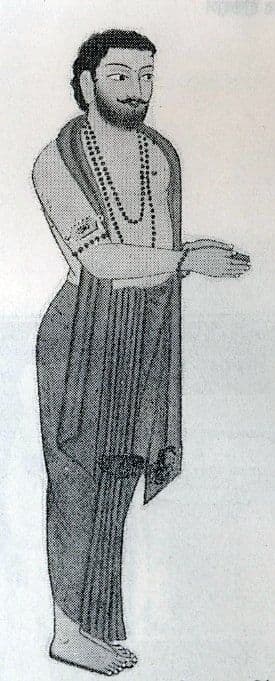
A printed portrait of the Shakta poet Ramprasad Sen, reproduced in Dinendra Chandra Sen's Brihad Banga, Calcutta University, 1935.

A printed portrait of the Shakta poet Ramprasad Sen, reproduced in Dinendra Chandra Sen's Brihad Banga, Calcutta University, 1935.Jonoikobangali, via Wikimedia Commons

The Agomoni songs are not about a battle. They are about a family. Menaka dreams of her daughter Uma, married off to an ash-smeared, homeless, intoxicated Shiva in distant Kailash, and begs her husband to fetch the girl home. Uma arrives on Saptami; the house is full for four days; on Dashami she must go back. The Bijoya songs are the songs of that leaving. This is why Durga Puja feels the way it does to Bengalis, it is not primarily a victory festival but a ghare phera festival, a daughter's homecoming, with all of Bengal cast as her mother. Ramprasad Sen gave the form its voice in the eighteenth century; Kamalakanta carried it on.

ইতিহাস History

Where it came from

Agomoni and Bijoya songs belong to Shakta Padavali, the devotional song-poetry of Bengal's goddess tradition. Scholars divide that body into two streams: the metaphysical songs addressed to Kali, and the Umasangit — the Agamani and Vijaya songs, built not on theology but on domestic feeling.

The genre was made into a distinct form in the eighteenth century by Ramprasad Sen. His dates are uncertain and the uncertainty is itself informative: he is given as born about 1718 or about 1723 at Garalgachha in Hooghly, with the family house at Halisahar-Kumarhatta, and traditionally as dying about 1775 — but a kabulatipatra dated April 1794 carries his signature, which suggests he lived considerably longer than the standard account allows. He was patronised by Maharaja Krishnachandra Roy of Nadia, who gave him a hundred acres rent-free and the title Kaviranjana. His compositional innovation was to fuse Baul folk melody with classical raga and kirtan; the resulting style is called Ramprasadi.

Kamalakanta Bhattacharya (1772–1821), court poet of Maharaja Tejchandra of Burdwan, is the great successor. After him the line runs through Rasikchandra Ray (1820–1893) and Nilakantha Mukhopadhyaya (1842–1911), and in the twentieth century Rabindranath Tagore and Kazi Nazrul Islam both wrote in the genre.

Edward Thompson, writing in 1923, recorded how far these songs had penetrated: they were heard from labourers and villagers, not only from devotees. Agomoni was popular music before it was heritage, and the recording industry of the 1930s to 1960s — Hindusthan Record, INRECO, HMV — turned it into the standard Bengali Puja release.

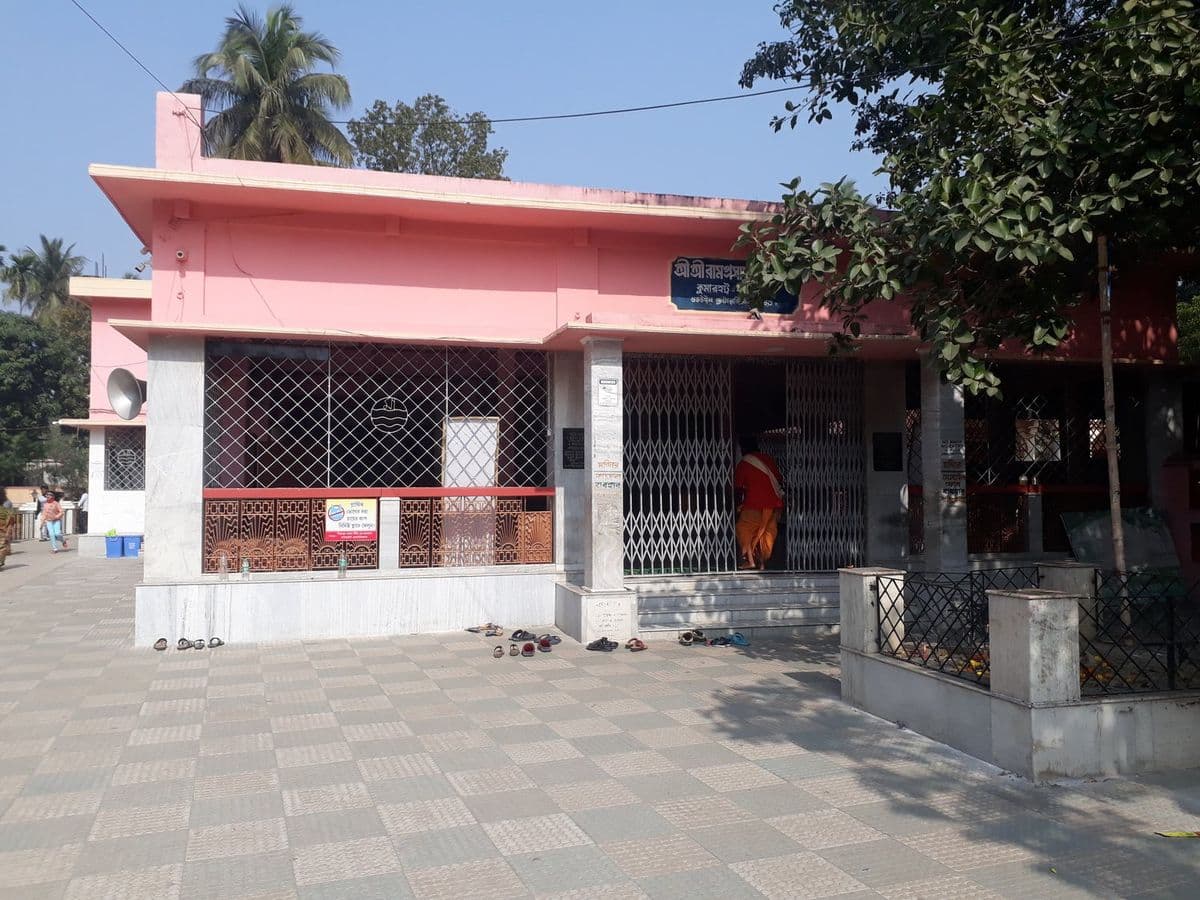
The Ramprasad Sen vita at Halisahar, North 24 Parganas: the heritage temple complex on the poet's ancestral homestead.
The Ramprasad Sen vita at Halisahar, North 24 Parganas: the heritage temple complex on the poet's ancestral homestead.Pinakpani, via Wikimedia Commons

সংস্কৃতি Culture

Who does it, and who used to

The Agomoni songs do not narrate a battle. They narrate a family, and the family is a poor Bengali one. Menaka, wife of the mountain king Himalaya, dreams of her daughter Uma, married off to Shiva — ash-smeared, homeless, intoxicated, penniless — and living far away in Kailash. Menaka begs Giriraj to go and fetch her. Uma arrives on Saptami; the house is full for four days; on Dashami she has to go back. The Bijoya songs are the songs of that return.

This is why Durga Puja feels the way it does to Bengalis, and it is a genuinely unusual theological move. Every structural feature of the Bengali festival follows from it: the five-day span, the welcome at bodhon, the feeding, the sindur khela in which married women send her off with vermilion exactly as a daughter is sent back to her husband's house, the sweets pressed on her at immersion, and the Bijoya embrace afterwards. The operative emotion has a Bengali name that does not translate — abhiman, the tenderness that is also reproach, of a mother who cannot say what she feels.

Who sings it has moved. This was household repertoire, sung by women in the weeks before Puja and learned from mothers; it is now largely professional and recorded. The canonical voices are recorded ones: Supriti Ghosh, Dwijen Mukhopadhyay, Sumitra Sen, Ramkumar Chattopadhyay, Arun Bhaduri. The genre's greatest Shyama Sangeet voice, Pannalal Bhattacharya, died in 1966 and has never been replaced.


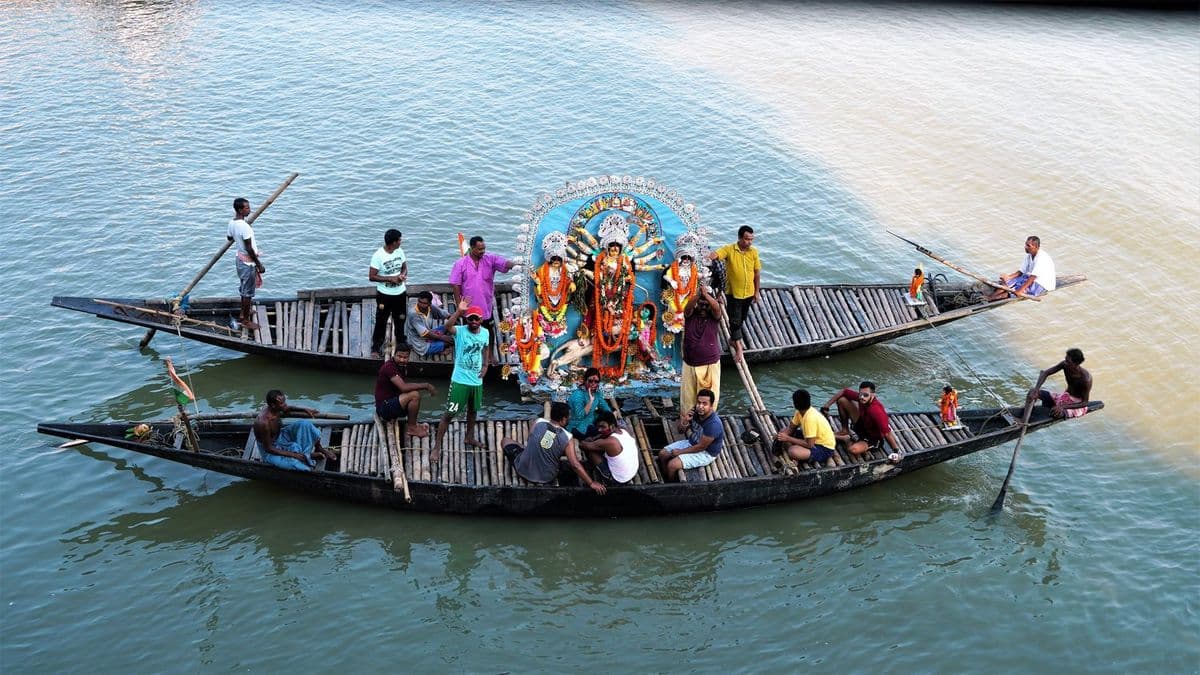
Three country boats lashed together carry a Durga in white pith ornament down the Ichamati at Taki on Bijoya Dashami.
Three country boats lashed together carry a Durga in white pith ornament down the Ichamati at Taki on Bijoya Dashami.Antkhan, via Wikimedia Commons

তাৎপর্য Significance

Why this, and not something else

The significance is a substitution, and it is the most important single fact about Bengali Durga Puja. Elsewhere in India the goddess of Navaratri is a warrior who kills a demon. In Bengal she is a married daughter home for four days.

Both are true of the same image. The clay figure has ten arms and a spear through a buffalo demon's chest; the songs sung in front of it are about a mother who cannot sleep because her child is married to a man with no house. Bengal did not replace the iconography. It kept the iconography and changed what people feel while looking at it.

The consequences are exact. Durga Puja is not a victory festival in Bengal; it is a ghare phera (ঘরে ফেরা) festival, a homecoming, and therefore also and inevitably a leaving. Dashami is grief, not triumph. Bengalis fast for no part of this festival and feed at every part of it, because you feed a daughter who has come home. Immersion is not the disposal of an image; it is a farewell at a station.

Agomoni is the text that makes this legible. Without it the ten arms mean what they mean everywhere else.

কীভাবে How it is made

The work itself

Agomoni is song-poetry, so the technique is prosodic and melodic together. The Ramprasadi style, which carries most of the older repertoire, sets a Bengali padavali lyric to a melody that borrows classical raga structure — Bhairavi, Mishra Kafi, Khambaj and Bhairav are the common choices for the dawn and departure moods — over a folk rhythmic base drawn from Baul practice. The result is singable without training, which was the point. The standard accompaniment is minimal: harmonium or esraj, tabla or khol, and tanpura. Older recordings often add flute. The tempo is slow and the ornamentation restrained, because the words are meant to be understood; meend and gamak are used sparingly, and the melodic line usually follows the natural stress of the Bengali line rather than overriding it. The formal unit is the padavali verse with a repeated refrain called dhuya, which the listener can join. Umasangit lyrics use the vocabulary of ordinary family speech — ma (mother), meye (daughter), jamai (son-in-law), ghar (house) — rather than Sanskritic devotional diction, and this plainness is deliberate and is the genre's signature.

আগমনীagomoni
"Of the coming" — the songs of Uma's journey home to her parents before Durga Puja.
বিজয়াbijoya
The songs of Dashami, when the daughter must return to Kailash; also the greeting exchanged after immersion.
উমাসঙ্গীতUmasangit
The family-narrative stream of Shakta Padavali, of which Agamani and Vijaya are the two halves.
রামপ্রসাদীRamprasadi
The song style created by Ramprasad Sen, fusing Baul melody with classical raga and kirtan.
অভিমানabhiman
Hurt affection — the tenderness that is also reproach; the operative emotion of the whole genre and untranslatable.
ঘরে ফেরাghare phera
Homecoming — what Bengalis understand Durga Puja to be about, as opposed to victory.
শাক্ত পদাবলীShakta Padavali
The body of Bengali goddess song-poetry to which Agomoni, Bijoya and Shyama Sangeet all belong.
ধুয়াdhuya
The repeated refrain of a padavali song, which the audience joins.

কাহিনি The stories

What people tell each other about it

The fence and the girl

The best-known Ramprasad story: the poet was mending the bamboo fence around his house, and a radiant young girl appeared and held the ties for him while he worked, asking him to sing as he did. When he had finished she was gone, and he understood that Kali had spent the afternoon doing manual labour with him. The story is told to explain why his songs speak to the goddess the way a man speaks to a relative — scolding, bargaining, complaining about money, occasionally furious. It is hagiography, not biography, and Bengalis tell it anyway, because it is exactly what the songs sound like.

The signature of 1794

Ramprasad Sen is conventionally said to have died in about 1775, and the date is repeated everywhere. There is a document that contradicts it: a kabulatipatra — a written undertaking or lease — dated April 1794 and bearing his signature. If the signature is his, he outlived his traditional death date by nearly twenty years. His birth is equally unsettled, given variously as about 1718 and about 1723. For the poet who effectively created a Bengali song genre, we do not securely know when he was born or when he died, and the standard dates should be given with that caveat attached.

A festival that is not about the battle

In the Devi Mahatmya, Durga is a warrior assembled from the pooled anger of the gods to kill a demon nobody else can kill. In the Agomoni songs, sung in front of that exact image, she is Uma — somebody's daughter, married off young to an unemployed ascetic who lives on a mountain, home for four days a year while her mother cooks and cannot stop looking at her. Bengal kept the ten arms and the spear and changed the whole emotional content of the festival. It is why Dashami is a day of grief in Bengal and a day of triumph almost everywhere else.

The songs the labourers knew

Edward Thompson, writing on Bengali religious lyrics in 1923, recorded something easy to lose: Ramprasad's songs had penetrated so far into Bengali life that they were sung by labourers and villagers as ordinary working music, not only by devotees at worship. Agomoni was popular repertoire before it was classified as heritage. A century later the transmission has inverted — it survives chiefly as professional recording and concert programme, while the household singing it came from has largely stopped. The songs are better preserved and less widely known than they were when Thompson heard them in a field.

দেখুন Watch

Agamoni | Bengali Devotional Songs | Ebar Aamar Uma Eley | Maa Durga SongsINRECO BENGALIINRECO's archive collection of Agomoni songs, including Ebar Aamar Uma Eley, from the historic Bengali record catalogue.
Bengali Devotional Songs | Ramkumar Chatterjee | Shyama Sangeet | Agamani SongsHindusthan RecordHindusthan Record's collection of Ramkumar Chattopadhyay singing Shyama Sangeet and Agamani, one of the canonical recorded voices.
Bangla Devotional Documentary | Matrisadhak Ramprasad | মাতৃসাধক রামপ্রসাদ | Gold DiscRDC Banglar GeetiA Bengali documentary on Ramprasad Sen, the poet who made Shyama Sangeet and the Agomoni song into distinct genres.

এখন Now

What state it is in

Evolving, and unevenly. Agomoni is no longer common household repertoire: very few Bengali families now sing it at home in the weeks before Puja, and most people encounter it as a recording or in the Mahishasuramardini broadcast, which is built substantially from Agomoni lyrics. Professionally it is healthy. New Agomoni albums are released every Mahalaya season, and the catalogues of Hindusthan Record, INRECO, Saregama and HMV keep the historic recordings in circulation on streaming platforms. Live Agomoni performance is a fixture of the Mahalaya-week concert circuit in Kolkata and in every substantial diaspora puja. Among living singers, Swagatalakshmi Dasgupta is the most consistently recorded interpreter of the classical Agomoni line, and Aditi Munshi is the leading contemporary devotional and kirtan voice in Bengal. Neither is a Shyama Sangeet specialist in the older sense, and the honest position is that the genre's benchmark voices are all dead: Pannalal Bhattacharya, Dhananjay Bhattacharya, Supriti Ghosh, Dwijen Mukhopadhyay, Sumitra Sen. Serial television has become an unexpected transmission channel: Bengali daily soaps built on Ramprasad's life have put Shyama Sangeet in front of large audiences who would not seek it out.

যা দেবী সর্বভূতেষু বুদ্ধিরূপেণ সংস্থিতা। নমস্তস্যৈ নমস্তস্যৈ নমস্তস্যৈ নমো নমঃ॥

To the Goddess who abides in all beings as intelligence, salutation, salutation, salutation again and again.

Devi Mahatmya 5.20