Skip to content
All art forms

Performance

চণ্ডীপাঠ ও মহিষাসুরমর্দিনী

Chandipath and Mahishasuramardini

Devi Mahatmya, c. 5th-6th century CE, in the Markandeya Purana; the radio version from Akashvani Calcutta, 1931

Where it stands

Thriving

Akashvani (All India Radio) Kolkata, which has broadcast Mahishasuramardini every Mahalaya since 1931; for live Chandipath, Bengal's growing cohort of women purohits

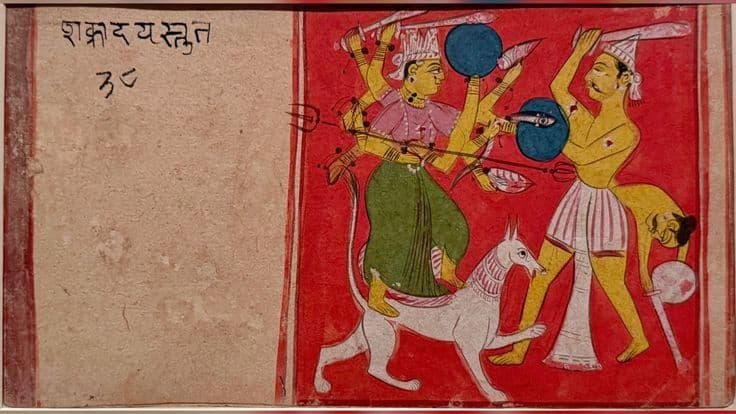
A seventeenth-century West Bengal Devi Mahatmya folio headed Shakradaya-stuti: the Devi on her lion spearing an asura in flat red and yellow.

A seventeenth-century West Bengal Devi Mahatmya folio headed Shakradaya-stuti: the Devi on her lion spearing an asura in flat red and yellow.SpeakingArch, via Wikimedia Commons

The Chandi is 700 Sanskrit verses in thirteen chapters, and in Bengal it is never read silently. It is recited aloud in a fixed cadence and pitch contour, learned from a teacher, performed to a listening room, and judged as a style. Its greatest performance is a radio programme. Since 1931, at four in the morning on Mahalaya, Akashvani has broadcast Mahishasuramardini, Bani Kumar's script, Pankaj Mullick's music, and Birendra Krishna Bhadra's ninety minutes of narration and scriptural recitation. It is the sound that starts the Bengali festival season. When the station tried to replace Bhadra with a film star in 1976, the public revolt was so complete that the original was restored and never touched again.

ইতিহাস History

Where it came from

The text is the Devi Mahatmya, also called the Durga Saptashati, Sri Sri Chandi, or simply Chandipath. It is not an independent scripture: it is chapters 81 to 93 of the Markandeya Purana, inserted into a considerably older frame text. Scholars date the insertion to roughly 400–600 CE; Wendy Doniger puts the Devi Mahatmya at about 550 CE and the surrounding Purana at about 250 CE. The hard terminus is the Dadhimati Mata temple inscription of 608 CE in Rajasthan, which quotes it — so by the early seventh century it was scriptural enough to carve on a wall. With its added opening and closing sections it runs to seven hundred verses, which is what saptashati means.

Its frame story is rarely told at pandals and is worth knowing. A defeated king, Suratha, and a merchant, Samadhi, dispossessed by his own wife and sons, meet in the forest hermitage of the sage Medhas. Medhas explains that both are bound by the goddess's Maya and narrates her three exploits. The two ruined men then make a clay image on a riverbank and worship it. The scriptural first Durga Puja is in spring, not autumn, and is performed by two bankrupts with no temple and no priest.

The most consequential modern event in the history of Chandipath is a radio broadcast. Mahishasuramardini was first aired from All India Radio Calcutta in 1931 — script by Bani Kumar, music by Pankaj Kumar Mullick, recitation by Birendra Krishna Bhadra, with Premankur Aatorthi, Nripendra Krishna Mukhopadhyay and Raichand Boral among those who put the first broadcast together. It ran live for thirty-five years and has been pre-recorded since 1966. It is one hour and twenty-nine minutes long, and it has been broadcast every Mahalaya since.

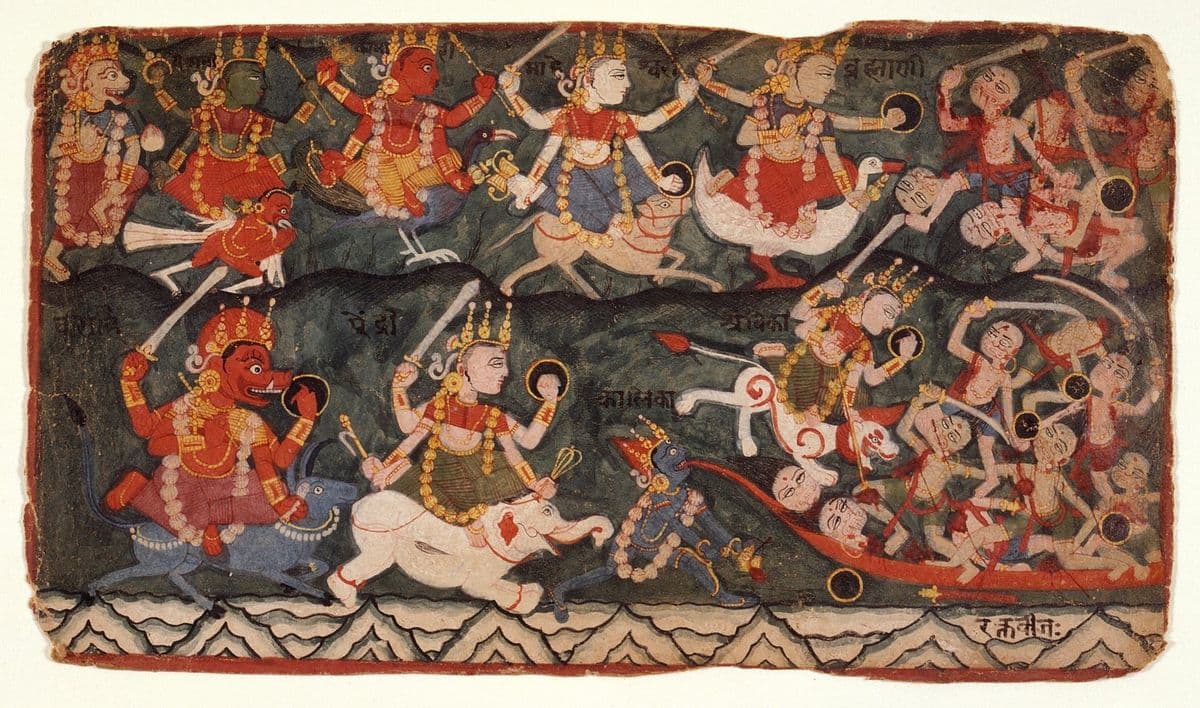
The eight mother goddesses ride into battle against Raktabija on their vahanas: a folio from an early nineteenth-century Nepali Devi Mahatmya.
The eight mother goddesses ride into battle against Raktabija on their vahanas: a folio from an early nineteenth-century Nepali Devi Mahatmya.Unknown Nepali, via Wikimedia Commons

সংস্কৃতি Culture

Who does it, and who used to

Chandipath in Bengal is not silent reading. It is vocalised recitation with a fixed cadence, pitch contour and speed — a style as recognisable as a raga, learned from a guru, performed aloud and judged aesthetically. The priest's recitation, the dhak's answer, the conch and the women's ululation are a single composed soundscape, and a Bengali listener can identify a good purohit by tempo alone.

The performer has conventionally been a male brahmin, and access to the recitation has been the clearest caste and gender boundary in the festival. Two things have eroded it. The first is the broadcast: Birendra Krishna Bhadra was an actor and radio professional, not a priest, and the most famous Chandipath in Bengali history is delivered by a layman. Bengal has listened to a non-priest recite the Chandi at four in the morning for ninety years without regarding it as irregular.

The second is recent and deliberate. In 2021 the 66 Pally puja in Kolkata engaged four women — Nandini Bhowmick, Ruma Roy, Semanti Banerjee and Poulomi Chakrabarti, of the collective Shubhamastu, founded in 2009 — to conduct the entire Durga Puja, Chandipath included. The theme was Mayer haate Mayer abahon, the Mother invoked by mothers. The group states that it has no head priestess. Women purohits now conduct pujas, weddings and shraddha across Kolkata, and their recitation is in Bengali translation as often as in Sanskrit, which is its own argument.

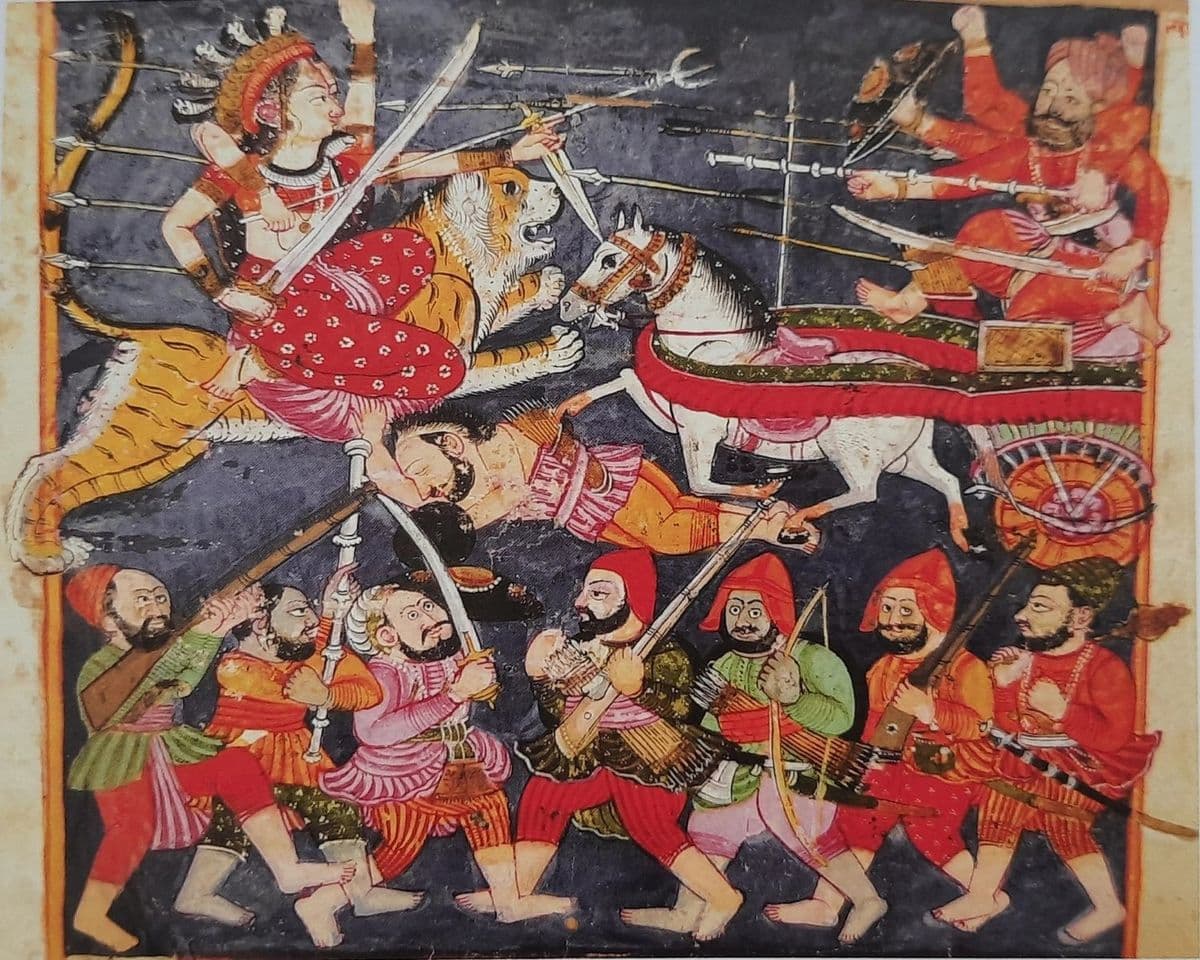
The goddess on her lion cuts through a demon army with chariot and foot soldiers, in a dispersed Devi Mahatmya folio.
The goddess on her lion cuts through a demon army with chariot and foot soldiers, in a dispersed Devi Mahatmya folio.Unknown, via Wikimedia Commons

তাৎপর্য Significance

Why this, and not something else

The Devi Mahatmya is the text that made the goddess sovereign rather than consort. Its theological move is stated in the Narayani Stuti and the Devi Suktam: the goddess is not a god's power personified but the substrate of everything, and the gods are her instruments. Every later Shakta development depends on this.

Its three episodes structure the whole Bengali liturgy. Madhu and Kaitabha gives the goddess as Mahamaya, the sleep from which Vishnu must be woken. Mahishasura gives the iconography that stands in every pandal. Shumbha and Nishumbha contains the Chamunda episode, and that is why sandhi puja exists: it commemorates the moment when Chanda and Munda ambushed Durga against the rules of battle and she manifested Chamunda from her third eye. The rite occupies the last twenty-four minutes of Ashtami and the first twenty-four of Nabami — exactly forty-eight minutes, on clock time — and is potent precisely because it belongs to neither tithi. One hundred and eight lamps are lit and one hundred and eight lotuses offered.

The recitation is therefore not commentary on the ritual. It is the source code. What is enacted over five days in clay, smoke and drumming is what is being said aloud in Sanskrit at the same time.

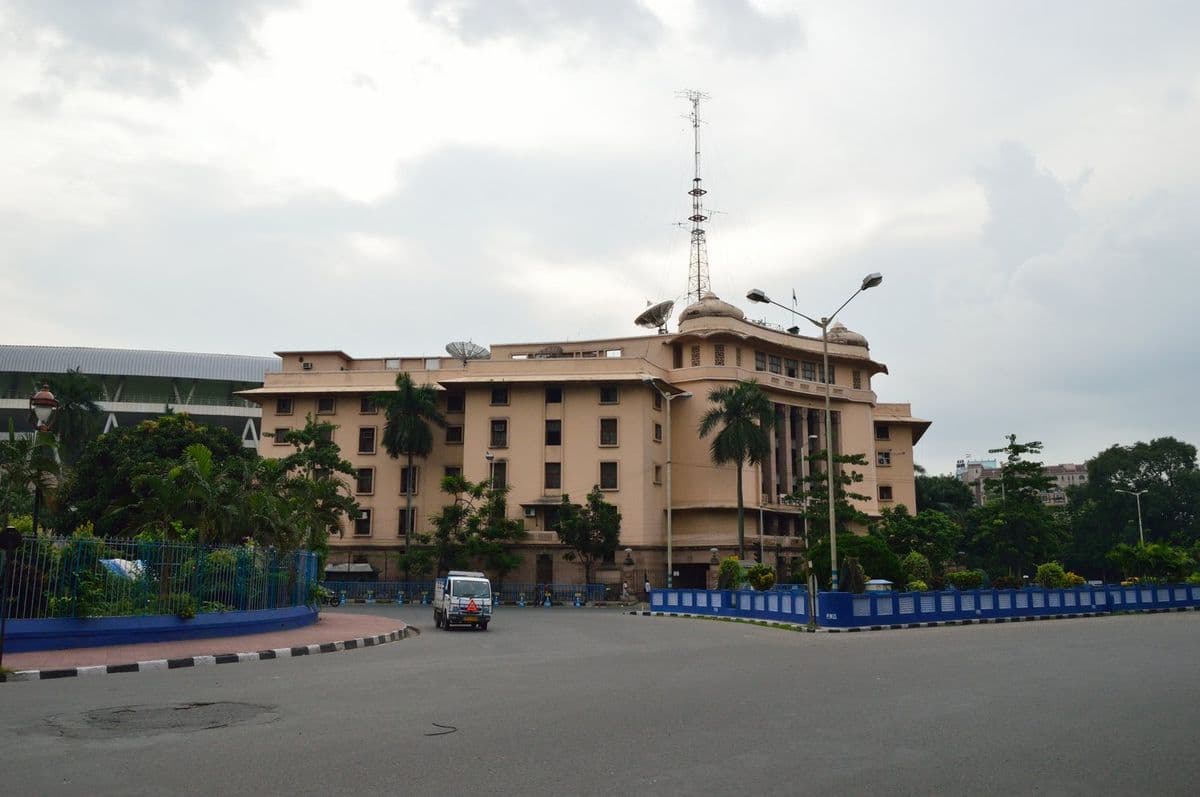
Akashvani Bhavan, Kolkata, the All India Radio building from which Mahishasuramardini has been broadcast every Mahalaya since 1931.
Akashvani Bhavan, Kolkata, the All India Radio building from which Mahishasuramardini has been broadcast every Mahalaya since 1931.Biswarup Ganguly, via Wikimedia Commons

কীভাবে How it is made

The work itself

Chandipath is chanted, not read. The reciter works from a fixed melodic contour with a narrow range, usually within a fourth, with a recognisable cadence at the end of each shloka and a faster, flatter delivery for narrative passages against a slower, more inflected one for the stutis — the hymn sections such as the Narayani Stuti and the Aparajita Stotra. Breath units are matched to verse units, so the recitation drives forward without audible gasping. Speed is a mark of competence; so is not losing pitch across seven hundred verses. The full ritual reading is preceded by the anga — the subsidiary texts that frame it: the Devi Kavacha, Argala Stotra and Kilaka, followed by the Ratri Suktam, and closed with the Devi Suktam. Omitting these is considered an incomplete reading. Sound is layered rather than sequential. The kansar plate, the shankha (শঙ্খ, conch) blown by women, and ulu-dhwani (উলুধ্বনি), the trilled ululation, punctuate the recitation at fixed points, and the dhak answers at the cadences. The whole is designed to be heard from the street and to tell a passer-by what stage the rite has reached.

চণ্ডীপাঠChandipath
The recitation of the Devi Mahatmya, chanted aloud with a fixed cadence rather than read silently.
দুর্গা সপ্তশতীDurga Saptashati
"Seven hundred" — the text's other name, from its verse count.
মহালয়াMahalaya
The new-moon day that ends Pitri Paksha, when the Mahishasuramardini broadcast airs at 4 a.m.
পুরোহিতpurohit
The officiating priest; since 2021 a role increasingly held in Kolkata by women.
স্তুতিstuti
A hymn section of the text, such as the Narayani Stuti, delivered more slowly and with more inflection than the narrative.
উলুধ্বনিulu-dhwani
The trilled ululation made by women that punctuates the recitation at fixed ritual points.
শঙ্খshankha
The conch, blown by women, which with the kansar and the dhak makes the sound-envelope of every consecrated moment.
সন্ধিপূজাsandhi puja
The 48-minute rite at the junction of Ashtami and Nabami, commemorating the manifestation of Chamunda.


কাহিনি The stories

What people tell each other about it

The first puja was performed by two bankrupts

The Devi Mahatmya frames itself as a consolation. A king, Suratha, has lost his kingdom to his own ministers; a merchant, Samadhi, has been thrown out by his wife and sons. They meet in the forest hermitage of the sage Medhas, who tells them they are both caught in the goddess's Maya and then narrates her three exploits. The two men make a clay image on a riverbank and worship it, and each gets what he wants. The scriptural original of Durga Puja is a spring rite, performed by two ruined men, with a clay image, no temple and no priest.

The year Bengal stoned the radio station

On 23 September 1976, All India Radio replaced Mahishasuramardini with a new programme, Devim Durgatiharinim, narrated by the film star Uttam Kumar. The reaction was immediate and physical: AIR offices were stoned, switchboards jammed, and the broadcaster apologised and restored Birendra Krishna Bhadra's recording. Uttam Kumar, who was among the biggest stars in Bengal, later described the experiment as converting a place of worship into a drawing room. It is a rare, well-documented case of an audience successfully defending a recording as heritage against the institution that made it.

An actor, not a priest

The most famous Chandipath in Bengali history is not recited by a purohit. Birendra Krishna Bhadra was an actor and a radio professional, and the voice that has opened Durga Puja for Bengal every Mahalaya since 1931 is a performer's voice, trained for a microphone. The programme was assembled by Bani Kumar from the Chandi and from contemporary devotional lyrics and set to music by Pankaj Kumar Mullick. It ran live for thirty-five years; the recording that plays now was made in 1966. Ninety-five years of Bengali ritual listening rest on a piece of scripted radio.

Four women conduct a puja

In 2021 the 66 Pally committee in Kolkata lost the veteran purohit who had run its Durga Puja for years. It engaged four women from the Shubhamastu collective — Nandini Bhowmick, Ruma Roy, Semanti Banerjee and Poulomi Chakrabarti — to conduct the entire festival, Chandipath included. The theme was Mayer haate Mayer abahon, the Mother invoked by mothers. Shubhamastu had been founded in 2009 and says it has no head priestess. They recite in Bengali translation as well as Sanskrit, on the principle that a worshipper should understand what is being said on her behalf.

দেখুন Watch

Mahalaya (Mahishasura Mardini) | Birendra Krishna Bhadra । Full AlbumSaregama BengaliSaregama's release of the full Mahishasuramardini as recited by Birendra Krishna Bhadra, the broadcast itself rather than a description of it.
Women Priests To Perform Rituals For The First Time In The History Of Durga Puja In Bengal | NewsMoIndia TodayIndia Today's report on the 2021 66 Pally puja, the first Durga Puja in Bengal conducted entirely by women priests.
Nandini Bhowmik - Lady Purohit, The Indian Priestess From KolkataLifeBeyondNumbersAn extended interview with Nandini Bhowmick of Shubhamastu on why she recites in Bengali translation alongside Sanskrit.

এখন Now

What state it is in

The broadcast is the healthiest ritual recitation in India. Mahishasuramardini airs on Akashvani every Mahalaya at four in the morning, is simulcast and streamed, and was dramatised in the 2019 Bengali film Mahalaya. Its audience is not devotional only; Bengalis who never enter a pandal set an alarm for it. Live Chandipath is in a different condition. Fewer families retain a household purohit, and paid recitation has consolidated into a small professional market around the large pujas. Priest-training schools attached to Kolkata temples and to the Ramakrishna order continue to teach the cadence, and printed and recorded Saptashati is widely available in Devanagari and Bengali script with transliteration. The genuine contemporary shift is who is reciting. The Shubhamastu collective, formed in 2009 and nationally visible after the 66 Pally puja of 2021, has made women purohits ordinary in Kolkata, and their practice of reciting in Bengali translation alongside Sanskrit is spreading. It has been contested by orthodox opinion and has not been stopped. For a festival whose entire liturgy addresses a goddess, the change was overdue and the arguments against it have been notably thin.

যা দেবী সর্বভূতেষু বুদ্ধিরূপেণ সংস্থিতা। নমস্তস্যৈ নমস্তস্যৈ নমস্তস্যৈ নমো নমঃ॥

To the Goddess who abides in all beings as intelligence, salutation, salutation, salutation again and again.

Devi Mahatmya 5.20