

Skip to content
All art forms

Performance

ধুনুচি নাচ

Dhunuchi Naach

Bengal; performed at Durga Puja, most intensely on Maha Ashtami and Bijoya Dashami

Where it stands

Thriving

The competition circuits run by major community pujas, for example Sarathi Socio Cultural Trust, Koramangala, Bengaluru, which runs formal dhunuchi, conch and dhak contests

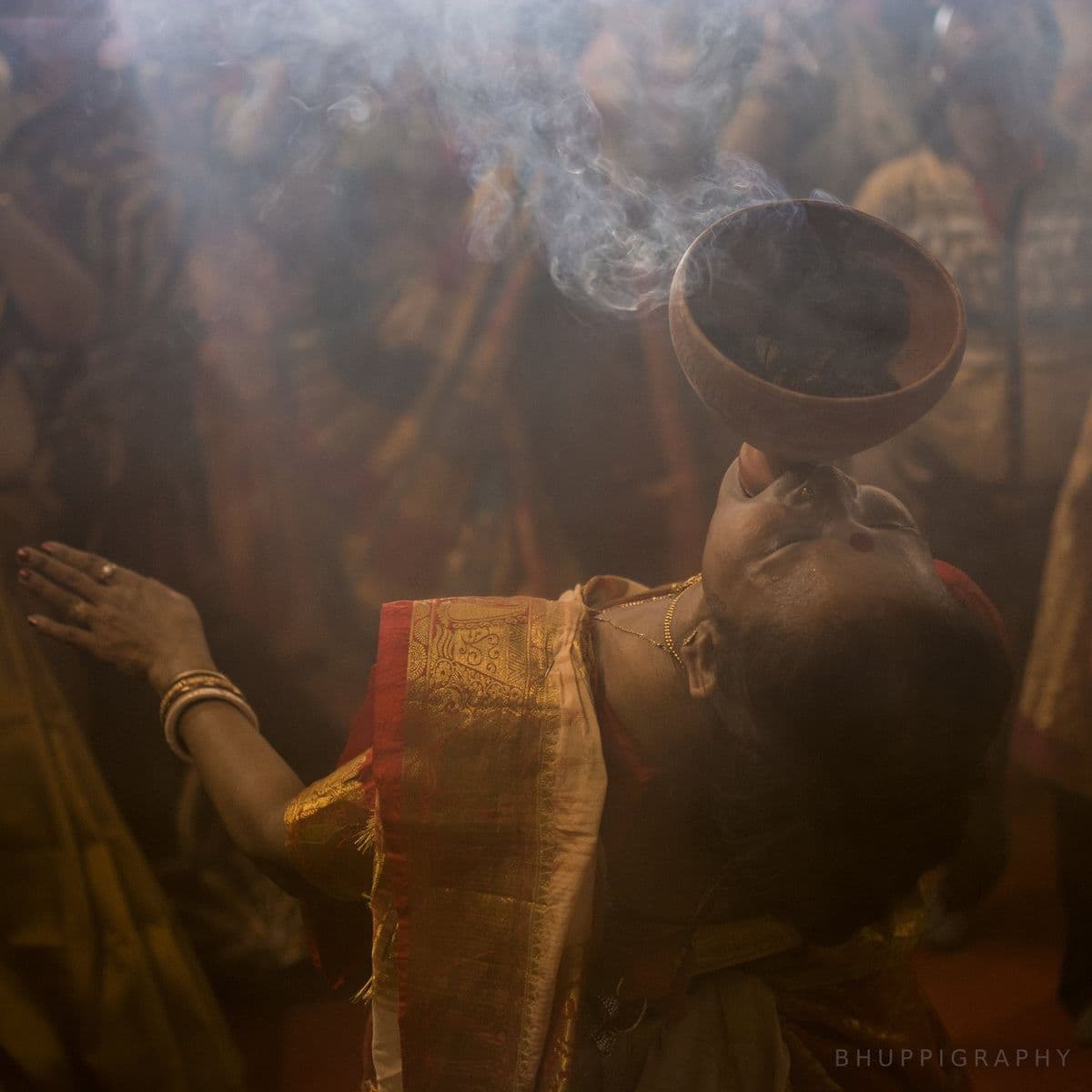
A dancer balances a burning dhunuchi by its rim in her teeth, head thrown back and one arm flung wide.

A dancer balances a burning dhunuchi by its rim in her teeth, head thrown back and one arm flung wide.Bhuppigraphy, via Wikimedia Commons

A dhunuchi is a flared earthen cup on a stem. Burning coal at the bottom sets alight a packed layer of dried coconut husk; resin and camphor are thrown on top; and out of it pours thick sweet white smoke. The dancer takes one in each hand, the show-offs take a third between their teeth, and swings them in long arcs to the dhak, spinning, crouching, trailing smoke through the crowd. Tradition says that when Durga fought Mahishasura for nine days, her devotees danced with fire to lend her strength, so it is framed as energy given to the goddess rather than a performance. Every community puja from Kolkata to Bengaluru to New Jersey now runs a competition.

ইতিহাস History

Where it came from

The dhunuchi is an earthenware censer: a wide flared bowl on a short stem, thrown on a potter's wheel by the same kumor caste that makes the images. Earthenware is used for a practical reason — the clay stem stays cool enough to hold while the bowl is full of burning coal.

Incense offered before a deity is old and pan-Indian. What is specific to Bengal is that the censer left the priest's hand and became a dance. There is no founding date for this, no text that prescribes it and no named originator; dhunuchi naach is not described in the Devi Mahatmya, the Kalika Purana or any of the ritual digests that fixed the Bengali Durga Puja calendar. It belongs to the lay, participatory layer of the festival, and it appears to have grown with the baroyari and sarbojanin pujas of the nineteenth and twentieth centuries, where large numbers of ordinary people were physically present at arati for the first time.

The story people tell is that during the nine days of battle Durga's devotees danced with fire and smoke to lend her strength, so the dance is energy given to the goddess rather than entertainment taken from her. This is a living explanation offered by practitioners, not a scriptural source, and it should be presented as such.

The competitive form — judged dhunuchi naach with prizes — is a twentieth-century club invention that spread with the community puja and is now standard from Kolkata to Bengaluru to New Jersey.

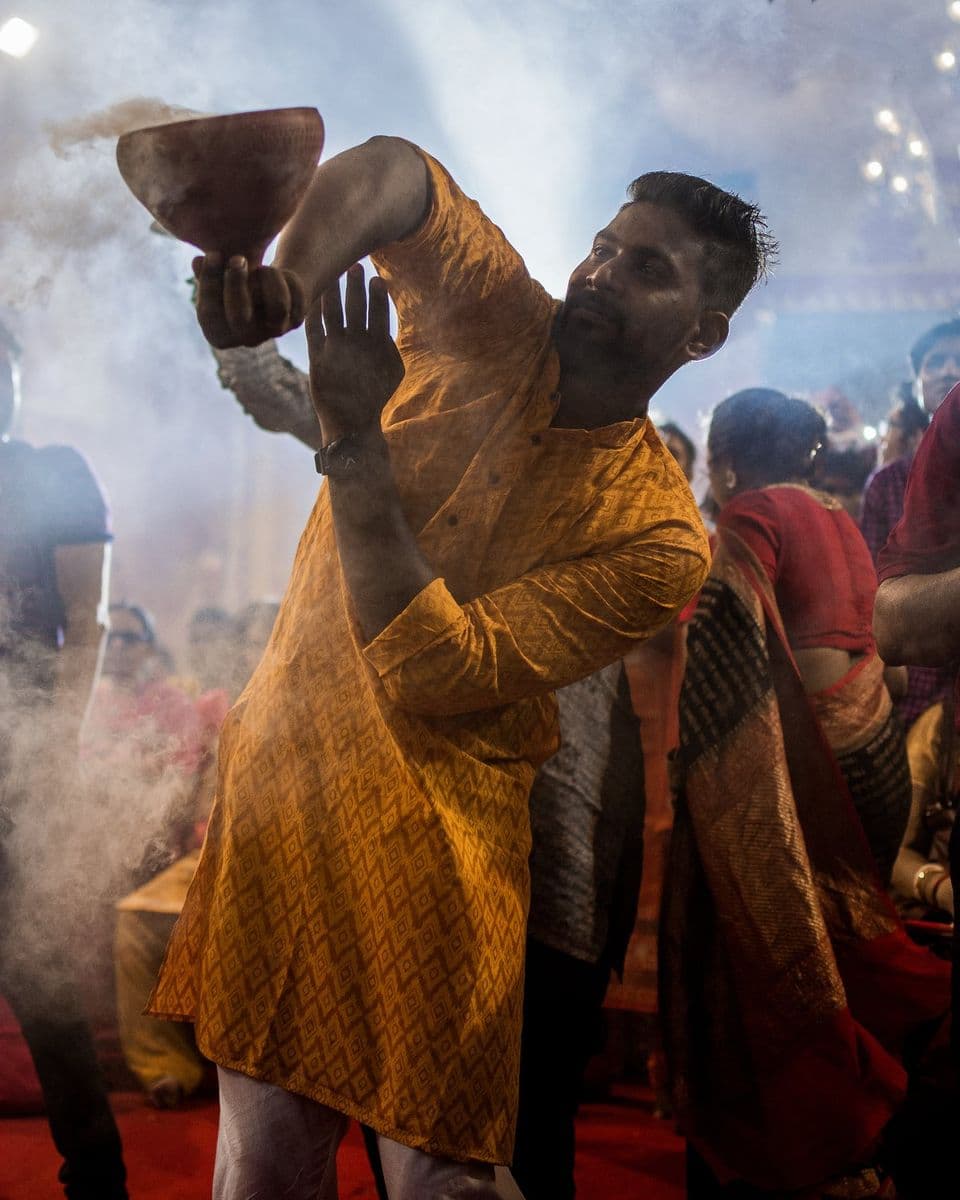
A dancer in a printed kurta swings a burning dhunuchi above his head, the crowd pressed close around him in smoke.
A dancer in a printed kurta swings a burning dhunuchi above his head, the crowd pressed close around him in smoke.Bhuppigraphy, via Wikimedia Commons

সংস্কৃতি Culture

Who does it, and who used to

Dhunuchi naach is the point in Durga Puja at which the audience becomes the performer. Everything else — the image, the pandal, the recitation, the drumming — is made by specialists for a public. This is done by whoever steps forward.

Who that is has changed. The Wikipedia entry describes it as traditionally performed by women; in Kolkata's community pujas through the twentieth century it was overwhelmingly men, stripped to a vest or bare-chested, and photographs from the 1970s onward show almost no women dancing. Both descriptions are defensible for different places and periods, and the honest summary is that practice varied by region and by household, and that the competitive club format made it public and male in the city before opening up again. Today both dance, and in Assam and in the diaspora women's dhunuchi naach is the more common form.

There is no caste restriction and no qualification. There is no guru, no examined technique and no lineage, which is unusual in an Indian performance form and is probably why it has stayed healthy: it cannot die out because nobody owns it.

Dress is conventional rather than prescribed — women in a red-bordered garad or atpoure sari, men in dhoti and kurta, often with a gamchha at the waist. The only real constraint is the dhaki, whose pattern the dancer must hold.

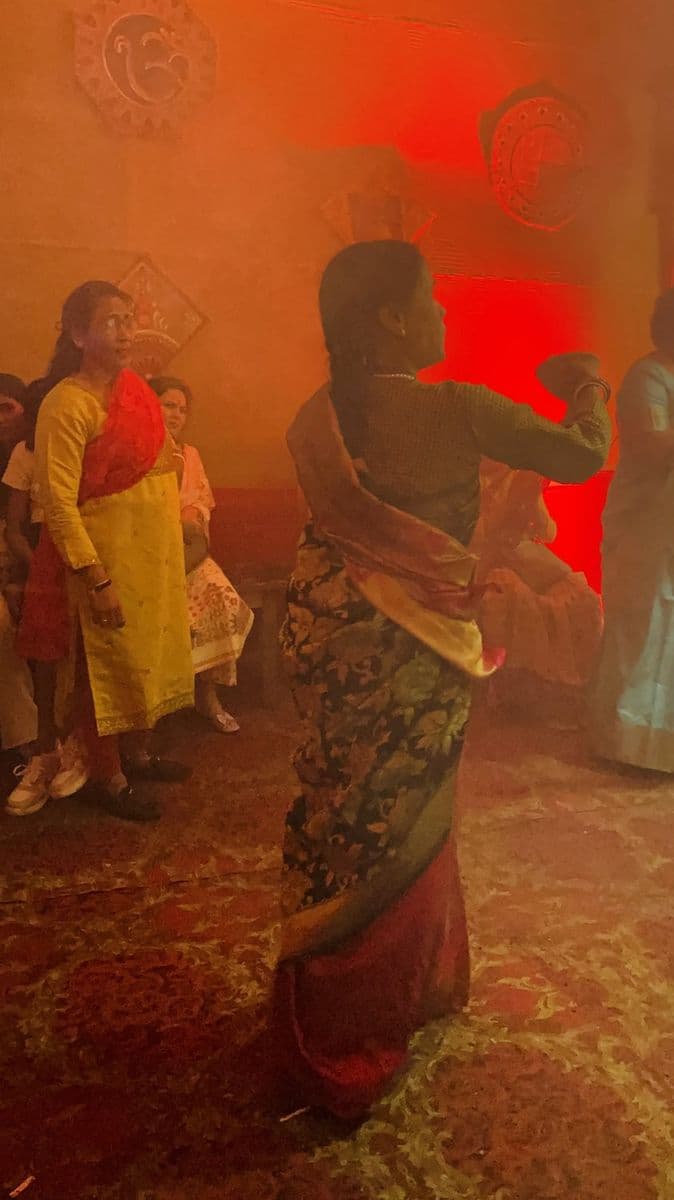
A woman in a sari dances with a dhunuchi in red-lit smoke at a Durga Puja in Dibrugarh, Assam.
A woman in a sari dances with a dhunuchi in red-lit smoke at a Durga Puja in Dibrugarh, Assam.AjayDas, via Wikimedia Commons

তাৎপর্য Significance

Why this, and not something else

The dance belongs to arati, the offering of light, and specifically to the most charged hours of the festival: Maha Ashtami around sandhi puja, Nabami, and Bijoya Dashami before the image goes to the river. It is not performed at a convenient time in the evening; it is performed at the junctions.

Smoke is the medium of offering. Dhuno, the sal resin sprinkled onto burning coconut husk, produces a dense sweet white smoke that fills the pandal and obscures the goddess in exactly the way incense is supposed to — the offering rises, the deity recedes, and the boundary between the worshipper and the image goes soft. The dancer is not performing in front of the goddess; he is making the air between them.

The physical form encodes the meaning. Wide arcs, spins, a drop to a crouch and a rise: the body traces the path of the smoke and does so at a tempo set entirely by the dhak. It is one of very few devotional acts in the Bengali festival that requires no words at all — no mantra, no Sanskrit, no priest, and therefore no literacy and no caste qualification. A person who cannot read the Chandi can still offer this.

Holding a third dhunuchi in the teeth is a display of control, and also of risk willingly taken.

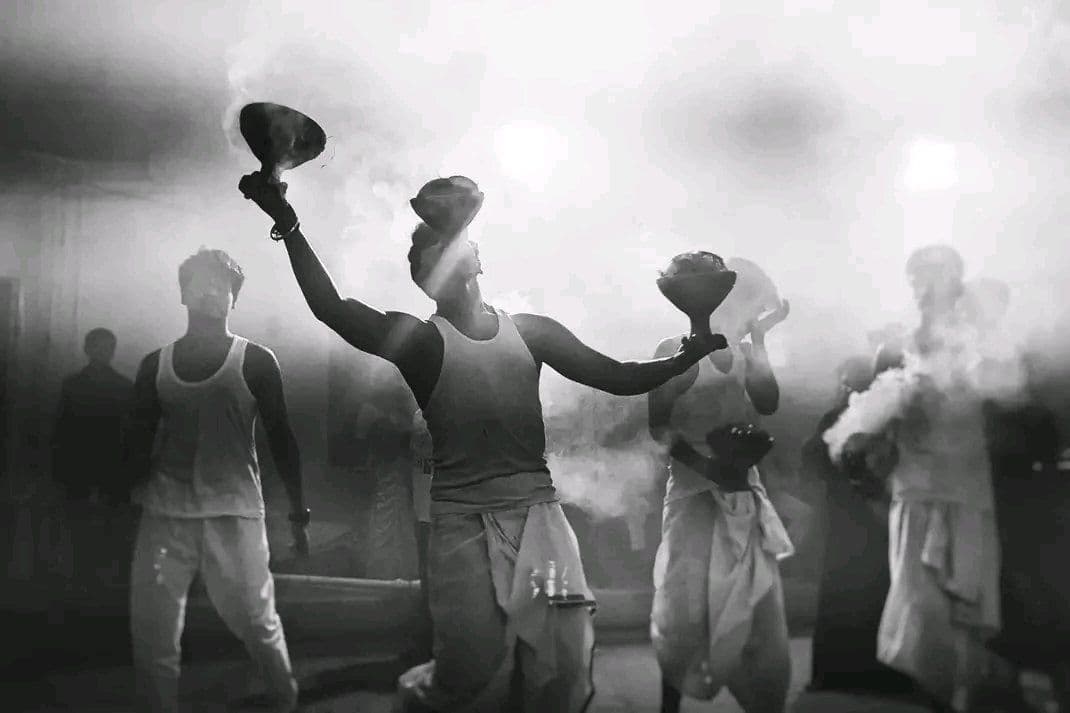
Four men in vests and dhotis swing earthen dhunuchis through thick smoke during evening arati at a Durga Puja.
Four men in vests and dhotis swing earthen dhunuchis through thick smoke during evening arati at a Durga Puja.Hizibizbizz, via Wikimedia Commons

কীভাবে How it is made

The work itself

The dhunuchi (ধুনুচি) is a flared, stemmed earthenware bowl. A layer of live coal goes in at the base. Over it is packed dried narkeler chhobra (নারকেলের ছোবড়া), coconut husk fibre, which smoulders rather than flames. Onto that the dancer or an attendant sprinkles dhuno (ধুনো) — sal tree resin — and sometimes kapur (কর্পূর, camphor) and incense powder. The resin melts, volatilises and produces a thick, sweet, opaque white smoke. Refilling is continuous: an attendant follows the dancer with a tin of dhuno. The grip is the whole technique. The censer is held by the stem, which is cool, with the bowl hanging out over the fingers; a second is held in the other hand; a virtuoso takes a third by the rim between the teeth, head tilted back, which fixes the neck and forces the dance into the shoulders and hips. Movement is broad and low-centred: arcs above the head, figure-of-eight sweeps at waist height, turns on the ball of the foot, and a crouch from which the dancer rises with both censers trailing smoke. The dhaki dictates tempo and the dancer lands on the accents. Burns to the wrists and forearms are common and treated as unremarkable.

ধুনুচিdhunuchi
The flared, stemmed earthenware censer held in the hands during the dance.
ধুনোdhuno
Sal tree resin, sprinkled onto smouldering coconut husk to make the thick white smoke.
নারকেলের ছোবড়াnarkeler chhobra
Dried coconut husk fibre, the fuel that smoulders over the coal.
আরতিarati
The offering of light before the deity, of which the dhunuchi dance is the participatory extension.
সন্ধিপূজাsandhi puja
The 48-minute rite spanning the junction of Ashtami and Nabami, when the dance is at its most intense.
কর্পূরkapur
Camphor, added with the resin for a brighter, sharper smoke.
গামছাgamchha
The coarse cotton towel worn at the waist by male dancers and used to wipe the hands between refills.

কাহিনি The stories

What people tell each other about it

The third dhunuchi

The standard form takes two censers, one in each hand. The advanced form takes a third, gripped by the rim between the teeth with the head thrown back, so that burning coal and resin sit directly above the dancer's face. A widely circulated photograph by the Kolkata photographer who works as Bhuppigraphy shows a woman in a gold-bordered sari doing exactly this, one arm flung out, smoke pouring past her jaw. There is no technique for it beyond nerve and a strong neck. Competition judges across the Kolkata circuit treat the third dhunuchi as an automatic advantage, and burns as the entry fee.

The story that is not in any book

Ask a dancer why this is done and the answer is usually the same: during the nine days of Durga's battle with Mahishasura her devotees danced with fire and smoke to lend her strength, and the dance is that strength still being offered. It is a good explanation and it is not scriptural. Nothing of the kind appears in the Devi Mahatmya, the Kalika Purana or the medieval ritual digests that fixed the Bengali festival's calendar. It is a living oral rationale for a practice whose actual origin is undocumented, which is worth saying plainly rather than repeating the story as history.

The one rite with no words

Almost every other act in a Bengali Durga Puja requires language, and language means Sanskrit, and Sanskrit means a priest. Pushpanjali is a repeated mantra. Chandipath is recitation. Sankalpa is a spoken vow. Dhunuchi naach requires nothing to be said by anyone. There is no qualification, no initiation, no lineage and no gatekeeper, and consequently no caste or gender bar that anyone has ever been able to enforce for long. It is the most participatory thing in the festival for a structural reason: you cannot exclude people from a rite that has no password.

Dry ice does not work

Several diaspora pujas, faced with venue fire regulations and smoke alarms, have tried to stage dhunuchi naach with electric censers, coloured LEDs or dry ice. It fails, and the reason is specific rather than sentimental. The point of the dhunuchi is that burning sal resin makes a smoke dense enough to obscure the goddess, so the offering visibly comes between the worshipper and the image. Cold vapour sits on the floor and clears. What is being offered in this dance is combustion, and a simulation of smoke offers nothing.

দেখুন Watch

Bengali women perform Dhunuchi dance to manic drum beats in front of Devi DurgaWildFilmsIndiaWildFilmsIndia's documentary footage of women dancing dhunuchi to live dhak in front of the image, filmed without staging.
Dhunuchi naach winner with 3 dhunuchi in durga puja at Powai Bengali Welfare AssociationBigBangBongA full competition-winning performance with three dhunuchis, useful for seeing the grip and the tempo relationship with the drum.

এখন Now

What state it is in

Thriving, and one of the few parts of the festival with no economic problem, because there is no economy: nobody is paid to dance dhunuchi naach and no craft depends on it beyond the potters who throw the censers. The competitive format is now near-universal. Community pujas across India and the diaspora run judged dhunuchi naach alongside conch-blowing and dhak competitions — the Sarathi Socio Cultural Trust in Bengaluru is one documented example among hundreds — and the prizes are small and the participation large. The circuit is the transmission mechanism: people learn by entering. Two changes are worth noting. Fire and smoke regulations in enclosed pandals and in overseas venues have pushed some pujas to restrict dhunuchi naach to open ground or to shorten it, and a few diaspora pujas have substituted electric or dry-ice imitations, which do not work. And social video has made the three-censer variant far more widely attempted than it used to be, with a corresponding increase in burns. There is no master, no school and no living legend, and that is a sign of health rather than neglect.

যা দেবী সর্বভূতেষু বুদ্ধিরূপেণ সংস্থিতা। নমস্তস্যৈ নমস্তস্যৈ নমস্তস্যৈ নমো নমঃ॥

To the Goddess who abides in all beings as intelligence, salutation, salutation, salutation again and again.

Devi Mahatmya 5.20