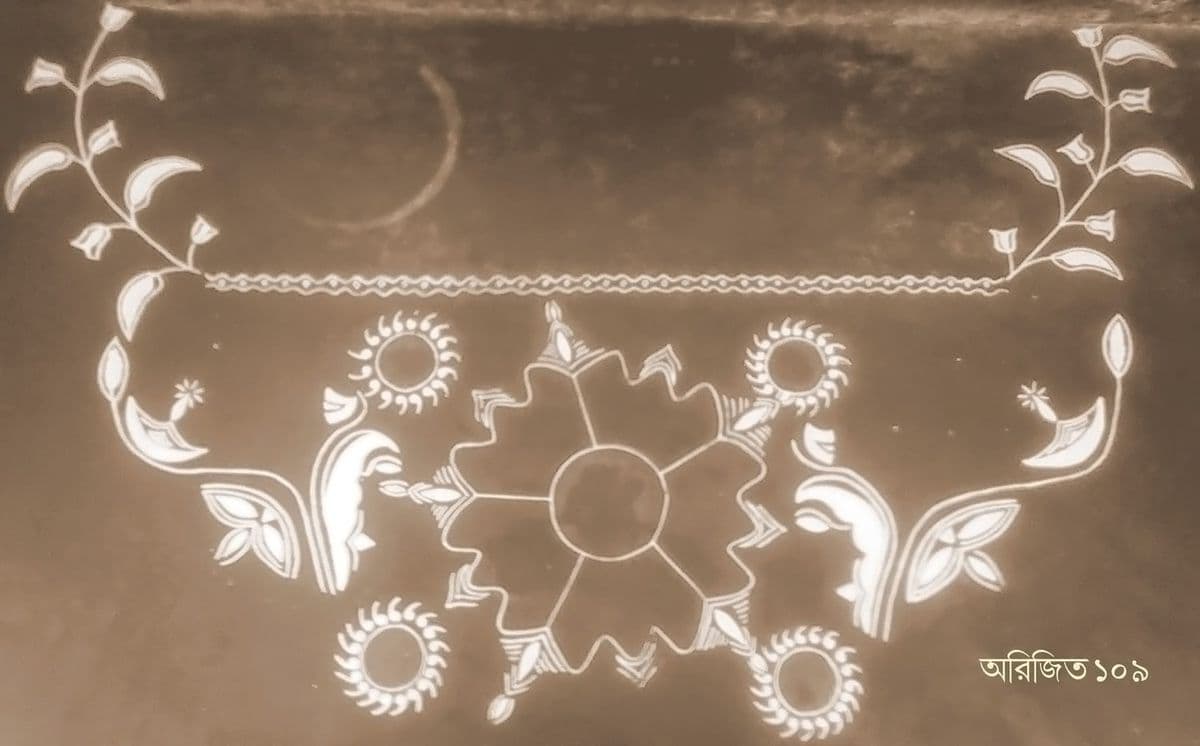
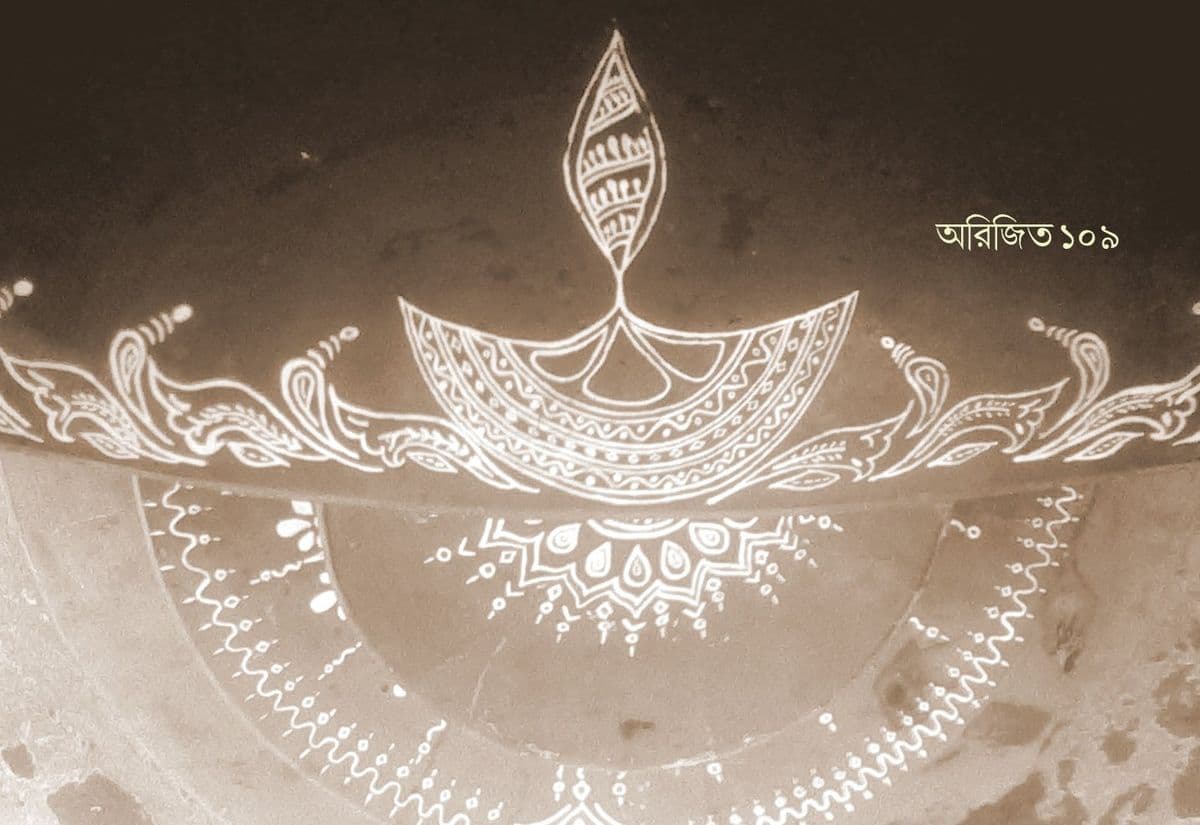
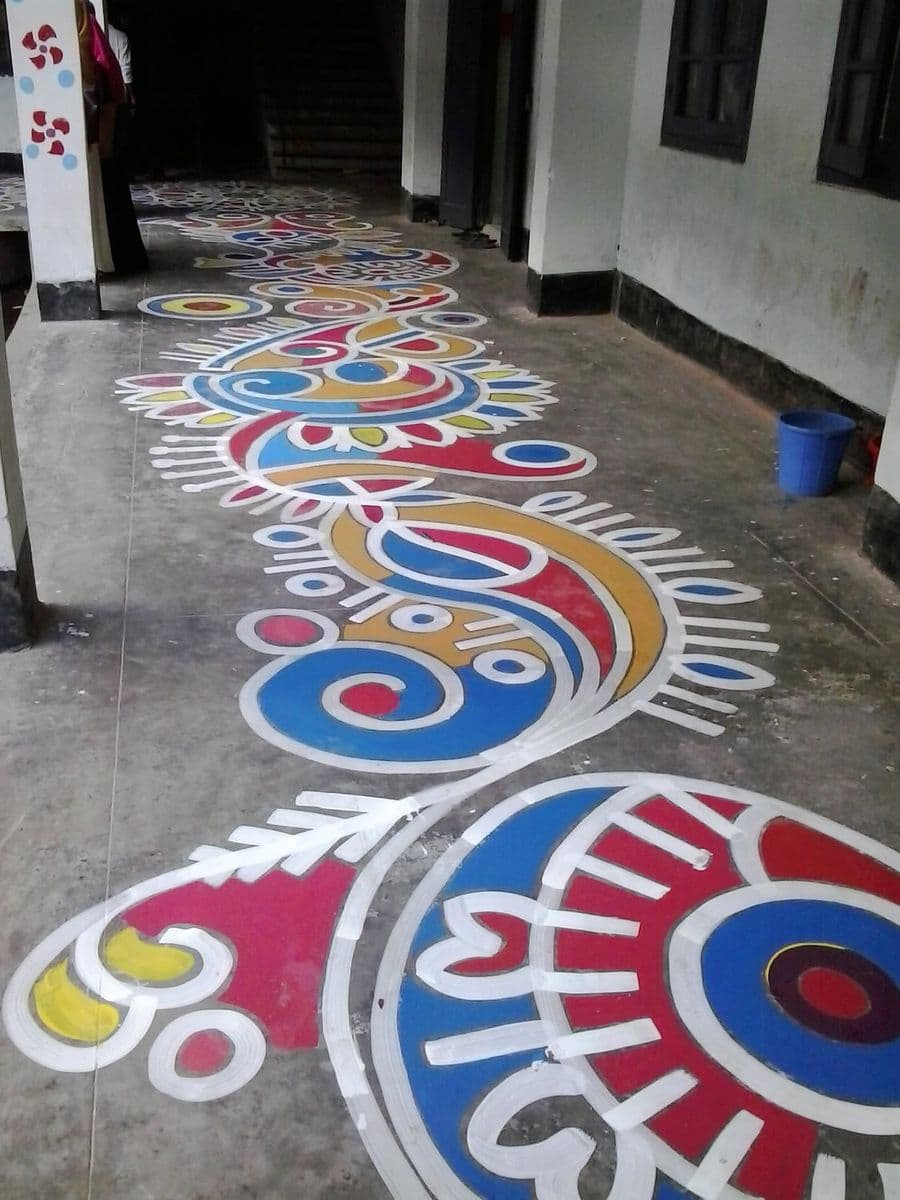
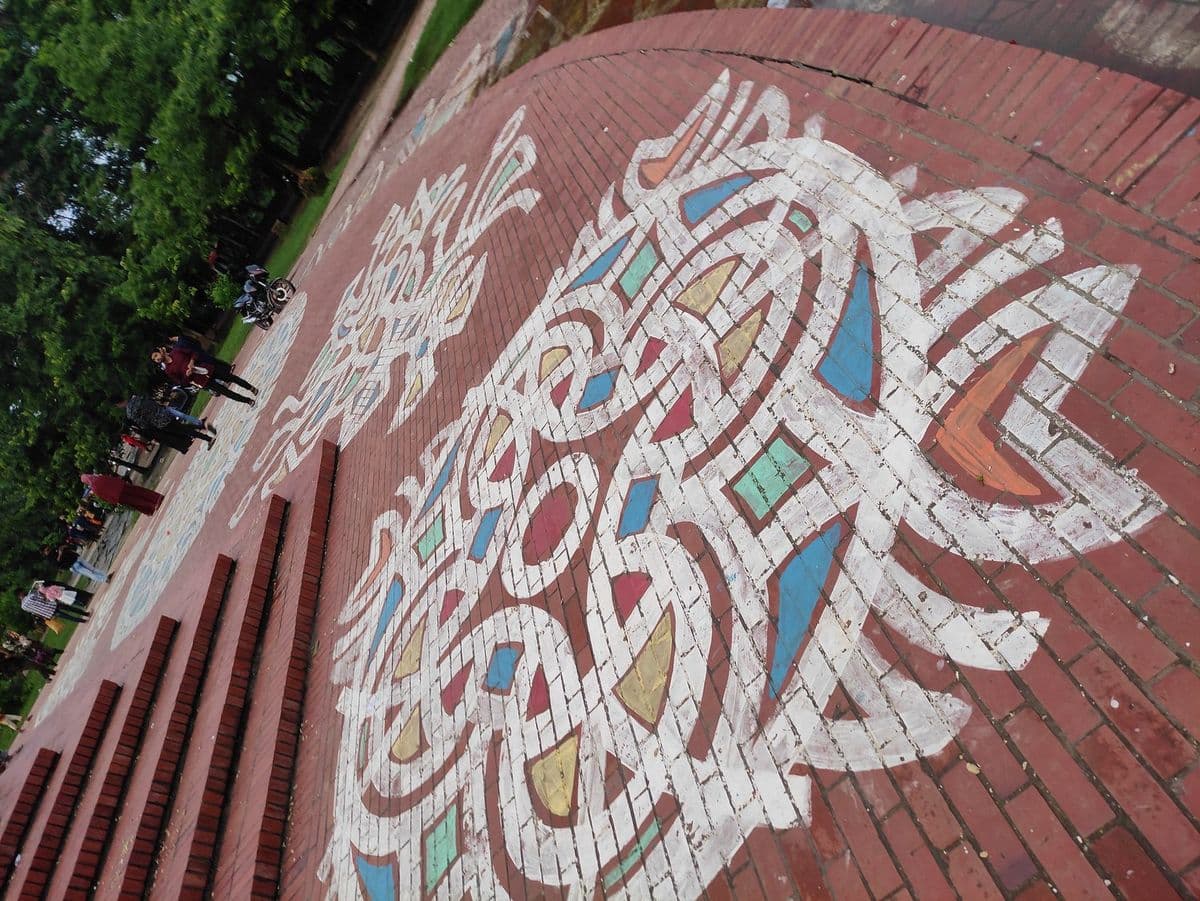
Alpona is ritual drawing in rice paste, made on the floor with the fingers. The word comes from the Sanskrit alimpana, "to plaster" or "to coat", which describes the action exactly: the hand smears rather than draws.
Its oldest layer is not decorative and not Durga Puja. It belongs to brata (ব্রত), the vows kept by unmarried girls and married women through the Bengali year — harit brata, sejuti, bhaduli, Lakshmi brata, punyipukur. In these rites a specific diagram is not an accompaniment to the vow; it is the instrument of it. The girl draws the figure while the brata-katha is recited, and the drawing is the petition. The motifs are agrarian and magical rather than aesthetic: sheaves of paddy, the owl that carries Lakshmi, fish, the lotus, the winnowing fan, the ladder, the swastika, and Lakshmir paa, the goddess's footprints, always drawn walking into the house and never out of it. Rice paste is used because rice is the wealth being asked for.
The second layer is modern, institutional, and can be dated. At Santiniketan, Rabindranath Tagore brought in Sukumari Devi, who carried the East Bengal alpona idiom, to teach. Nandalal Bose, who led Kala Bhavana from 1921, watched her work, took the form up and remade it: freed from the repetition and bilateral symmetry of folk practice, drawn with the asymmetry and compositional control of fine art. Jamini Roy photographed and chronicled its growth. The result — Santiniketan alpona — is now what most Indians picture when they hear the word, and Kala Bhavana formally built alpona into its foundation course in 2016.
Sukumari Devi is the one usually left out. She should be named first.