Three cloths carry the Bengali festival wardrobe, and they have separate histories.
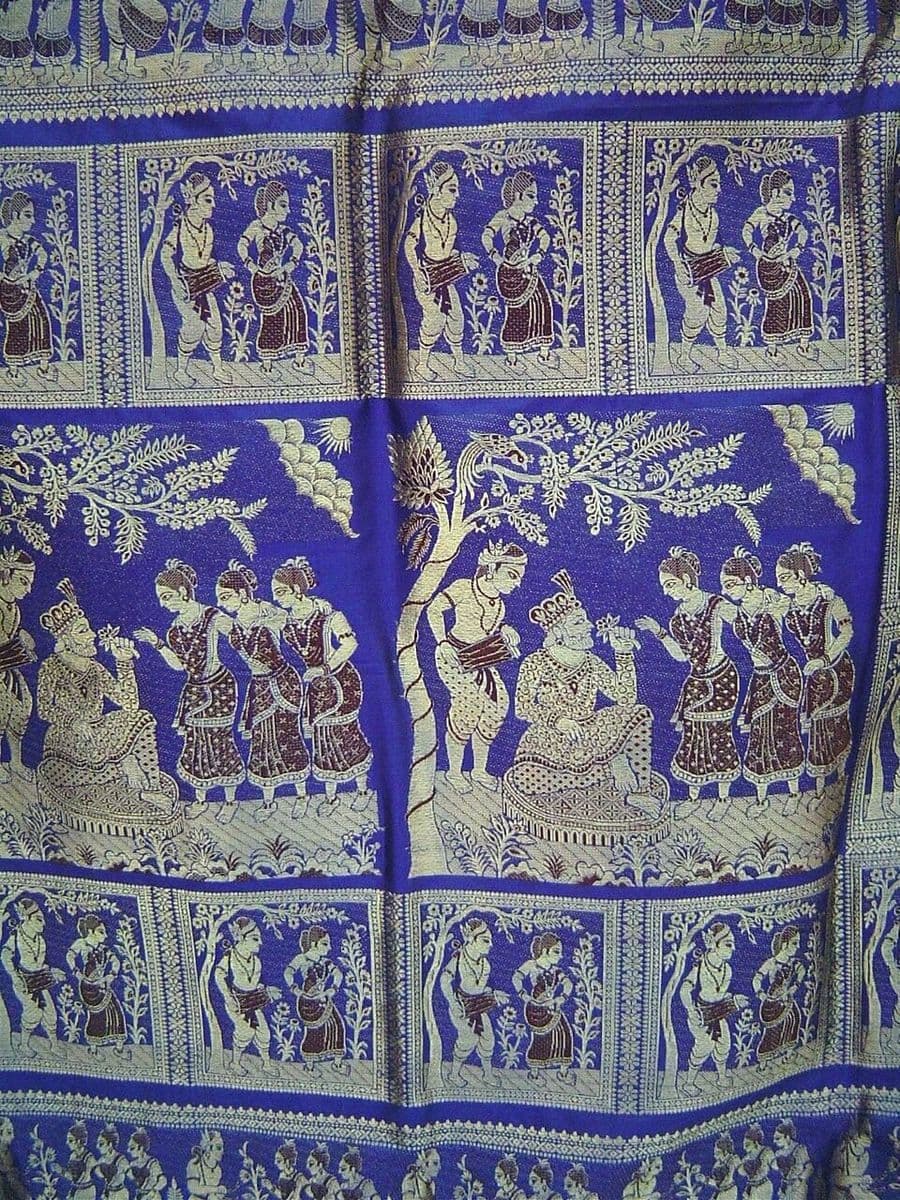
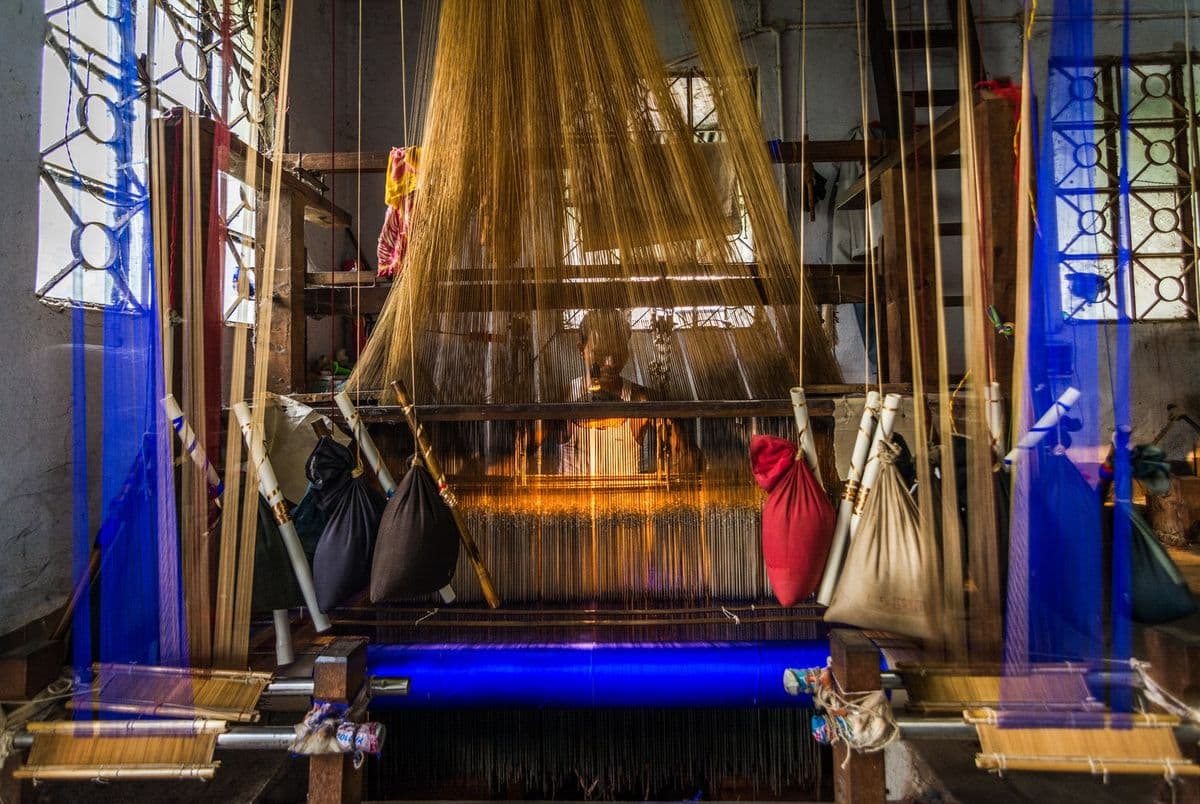
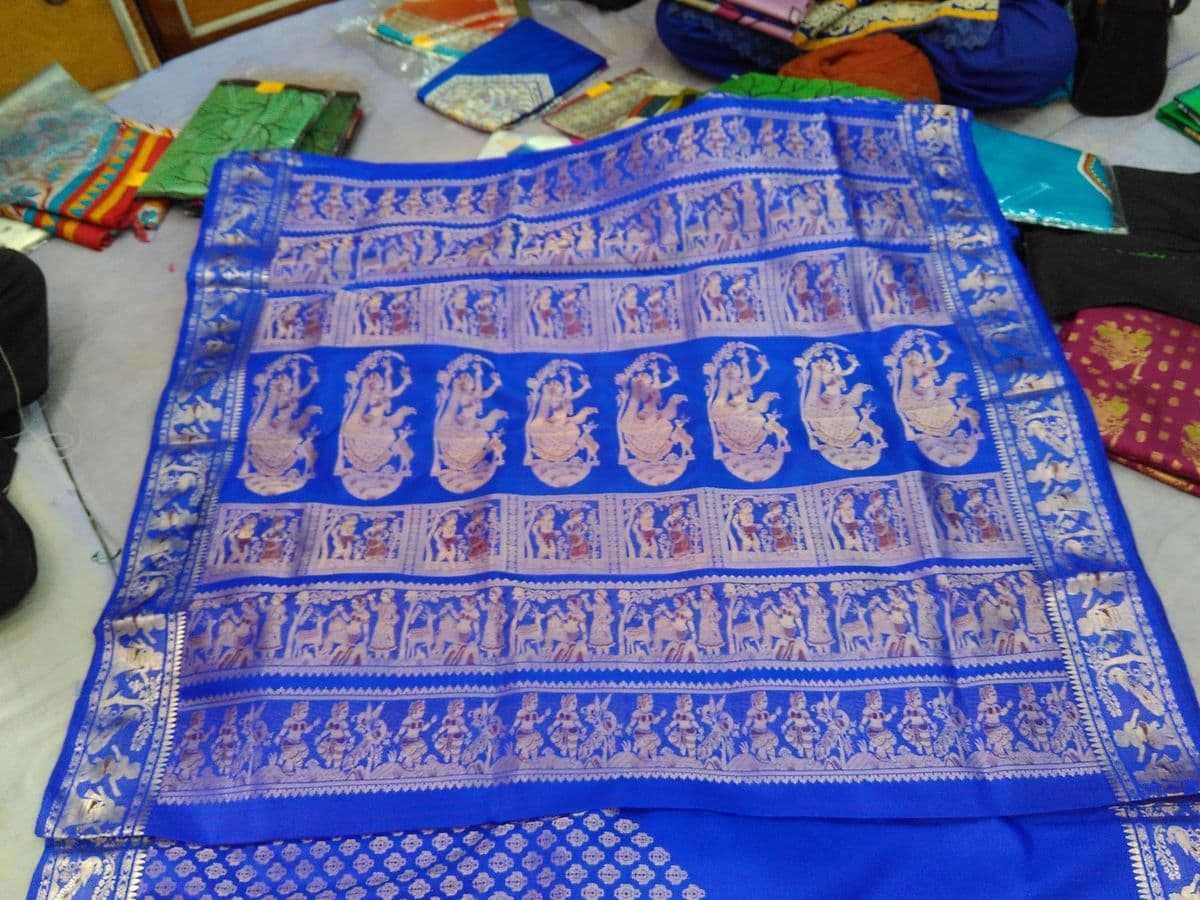
Baluchari is the youngest and the most literary. It is named for Baluchar, a village in Murshidabad near the Nawabi capital, where a figured silk brocade was woven in the eighteenth century under court patronage. Its pallu carries framed narrative panels — the Ramayana and Mahabharata, but also nawabi court scenes, women smoking hookahs, Europeans in carriages, and railway engines — and the strongest reading is that the weavers were copying the terracotta plaques of the temples they knew. Floods on the Bhagirathi in the nineteenth century destroyed Baluchar and dispersed the weavers. The craft was effectively dead by the early twentieth century, and was reconstructed at Bishnupur: the artist Subho Tagore brought the master weaver Akshay Kumar Das to learn jacquard weaving, and Das returned to Bishnupur and rebuilt the cloth on jacquard looms with the backing of Hanuman Das Sarda of the Silk Khadi Seva Mandal. Bishnupur is now effectively the only place authentic Baluchari is woven. It received a geographical indication in 2011, under application number 173.
Tant is the everyday cotton handloom of Bengal, and its centres are older than any of this. Weaving at Shantipur in Nadia is documented from the fifteenth century — the oldest date usually cited is 1409 — and it is mentioned in Advaita Mangal, the life of the Vaishnava teacher Advaita Acharya (1460–1558). Shantipur exported through the Mughal and early colonial periods. After 1947, weavers displaced from Tangail in East Bengal settled around Shantipur and Phulia and brought the Tangail idiom with them, which is why Phulia now weaves a jacquard-and-jamdani hybrid rather than pure Shantipuri cloth. Santipore saree took a GI in 2009 (application 138), Dhaniakhali saree in 2012 (application 176).
Jamdani is the oldest and the most technically extreme: figured muslin, woven around Dhaka, patronised by imperial Mughal warrant and probably named in Persian under Akbar or Jahangir. UNESCO inscribed the traditional art of jamdani weaving in 2013; Bangladesh gave it the country's first geographical indication in 2016.