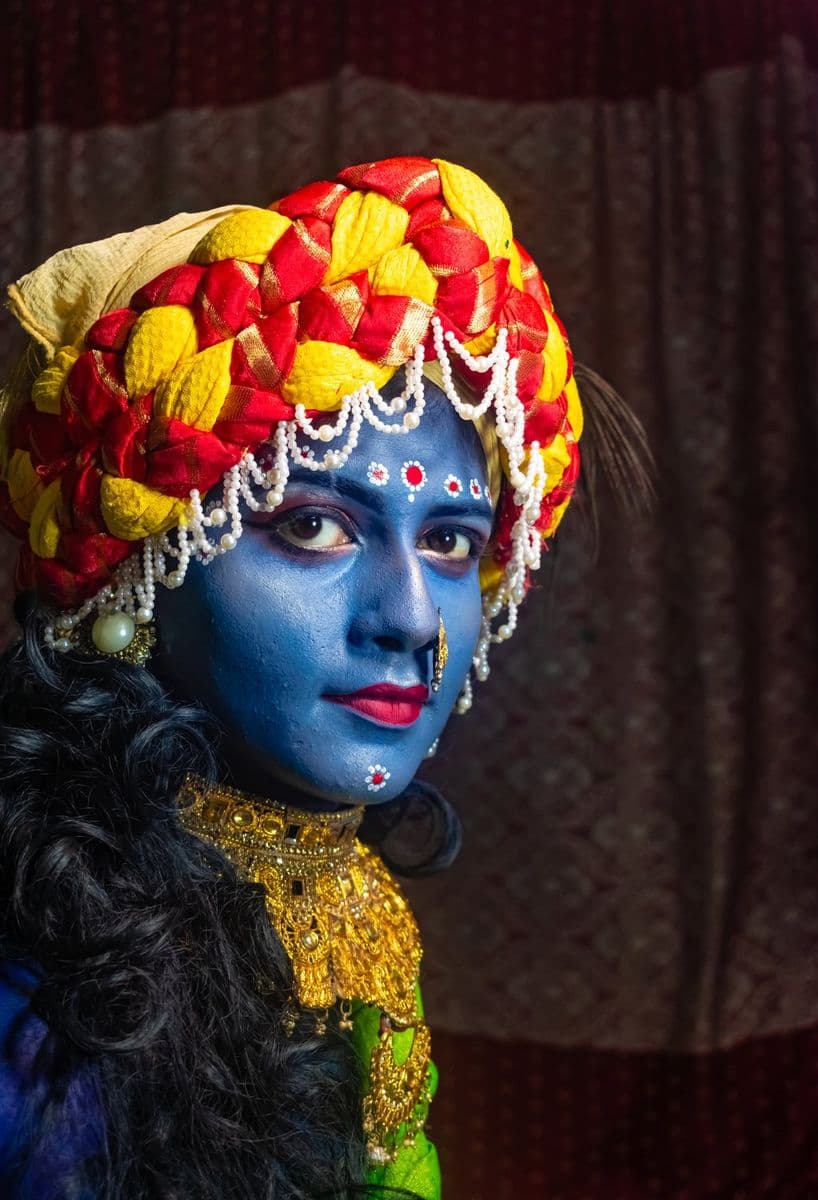
Jatra means going, or journey, and the name probably comes from the processions it grew out of. Its conventional origin is the Vaishnava bhakti movement of the sixteenth century: the Chaitanya Bhagavata records Chaitanya himself performing through the night in Rukmini Haran in 1507, and his followers Ramananda Ray and Rupa Goswami wrote Krishna plays under the patronage of the king of Puri. Earlier singing traditions — the charya songs of the ninth to twelfth centuries, Jayadeva's Gita Govinda, Chandidas's Srikrishna Kirtan — supplied the musical grammar. The form that emerges is Krishna jatra: sung, processional, devotional, played by men.
Secularisation came in the nineteenth century, and the pivotal figure is Gopal Ude (1817–1857), who formed his own company in Calcutta, rewrote Bidya Sundar and pushed jatra away from purely religious material towards melodrama and moral instruction. From there it split: one branch fed the proscenium theatre of the Bengal Renaissance, the other kept the open stage and the all-night performance. The stock allegorical character Bibek, meaning Conscience, who walks on unannounced and sings what the audience should be thinking, is not ancient. Scholars date it to the early twentieth century and disagree about its author — one account credits Ohibhushan's Surath Uddhar pala, while Kapila Vatsyayan attributes it to Mathursha — and it is usually read as a product of the same secularisation, with the Baul singer as its visual model. Niyati, Fate, often played by a woman, is the companion figure.
Jatra then became political. Mukunda Das, the charan kabi, wrote Matripuja (1905) after hearing Ashwini Kumar Dutta speak against the partition of Bengal, followed by Swadeshi Utsav (1906) and Rai Bahadur (1907). The government of Eastern Bengal and Assam banned the play and arrested him in 1908; he served three years for sedition. After Independence the form fed back into urban theatre through Utpal Dutt and the IPTA, and in 1968 Phanibhusan Bidyabinod became the first jatra performer to win a Sangeet Natak Akademi Award. The industry settled on Chitpur Road in north Calcutta, where the companies, the agents and the printers still are.