Skip to content
All art forms

Textile

কাঁথা ও নকশি কাঁথা

Kantha and Nakshi Kantha

Rural Bengal, both West Bengal and Bangladesh; a domestic tradition of unknown antiquity

Where it stands

Thriving

Shamlu Dudeja and the SHE Foundation, Kolkata, the kantha revival organisation, which supports over 80,000 women artisans in rural Bengal

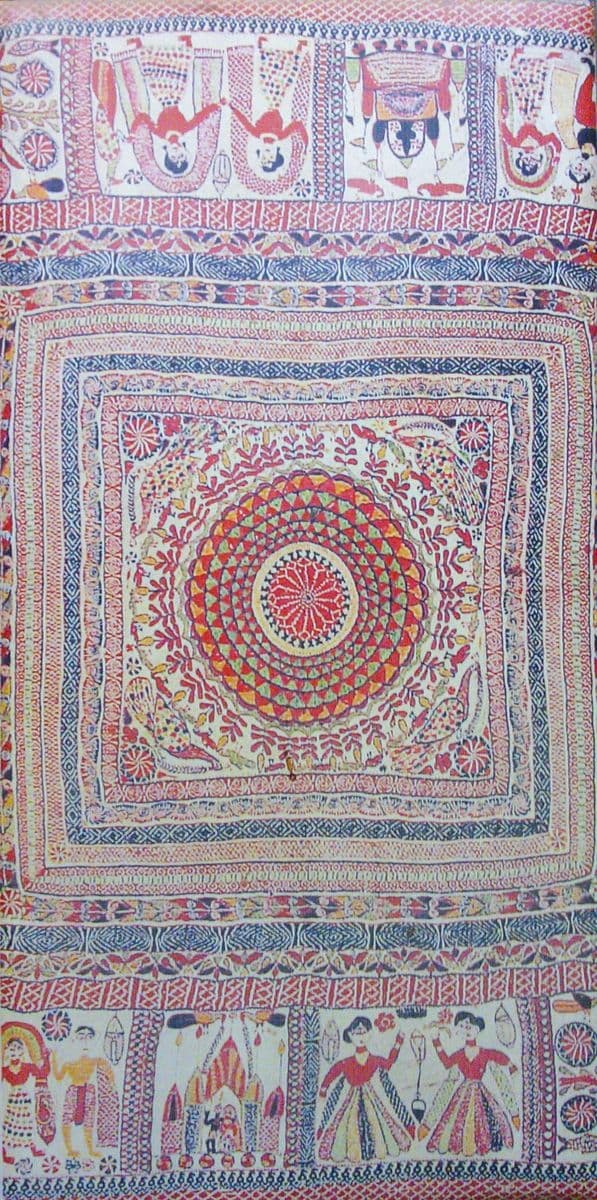
A nakshi kantha in the Sonargaon folk art museum, laid out from a central lotus medallion outward to the corners.

A nakshi kantha in the Sonargaon folk art museum, laid out from a central lotus medallion outward to the corners.Nahid Sultan, CC BY-SA 4.0, via Wikimedia Commons

Kantha began as thrift. Worn-out saris and dhotis were layered and quilted together with the simplest stitch there is, a running stitch, using thread pulled from the borders of the same old cloth. Nothing was bought and nothing was wasted. Over generations that utilitarian stitch turned into a language, lotuses, the tree of life, fish, elephants, sun and moon, whole narrative scenes, worked freehand without a frame by women making things for their own households, for a newborn, for a daughter to take away with her. The ripple the stitch leaves across the layers is the signature. It is the most purely domestic of Bengal's arts and now one of its largest rural employers.

ইতিহাস History

Where it came from

Kantha has no founding date, because it was never founded. It began as household thrift: worn-out saris and dhotis, too thin to wear, layered four or five deep and quilted together with a running stitch, using thread drawn from the coloured borders of the same old cloth. Nothing was bought. The oldest securely dated reference is in Krishnadasa Kaviraja's Chaitanya Charitamrita, composed in the late sixteenth century, where a kantha is sent as a gift — which establishes that the object existed and was worth sending, and not much else. Niaz Zaman's derivation of the word from Sanskrit kontha, rags, is the standard guess; others note that kantha has no clear etymological root at all.

The decorated version acquired its name much later and from a poet. Jasimuddin published Nakshi Kanthar Math in 1929, a narrative poem in which a woman stitches her life into a quilt, and the compound nakshi kantha — patterned kantha — entered general use from that book. It is one of the clearest cases in Bengali craft of a literary work naming a thing that had been made anonymously for centuries.

The twentieth century split the tradition twice. Partition scattered the regional styles — the Jessore, Faridpur, Rajshahi, Mymensingh and Bogra work on one side of the border, the Birbhum, Murshidabad and Nadia work on the other. Then, in the 1980s, Shamlu Dudeja came across women at a Kolkata craft market using the stitch for wall hangings and began organising the trade; she founded SHE, Self Help Enterprise, which was working informally from about 1990 and registered in 2003. That intervention converted a domestic practice into piecework for wages and made kantha a commercial embroidery on new silk and cotton, which is what almost all kantha sold today actually is. West Bengal registered Nakshi Kantha as a geographical indication in 2008 — the first of the state's handicrafts to get one. Bangladesh followed much later, protecting Jamalpur Nakshikantha in 2024.

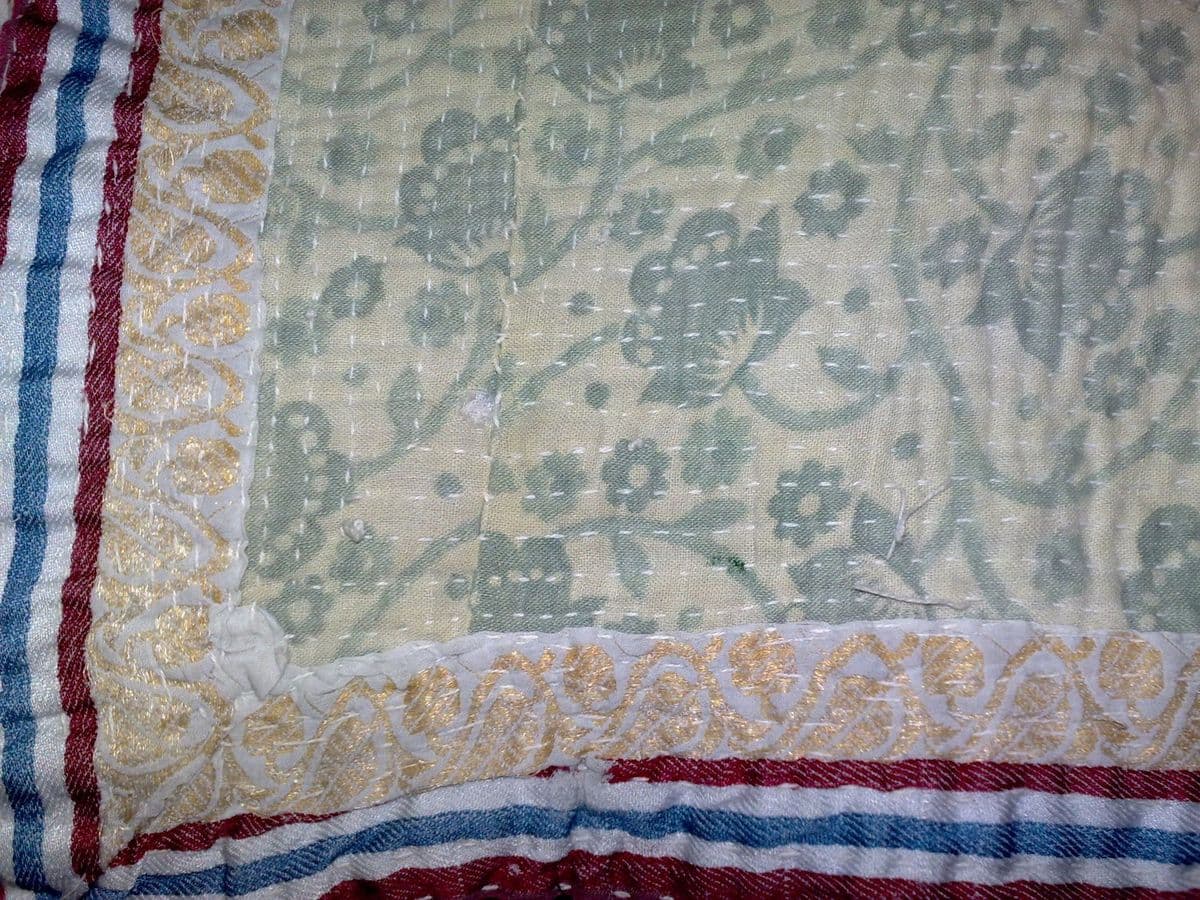
Kantha at close range: rows of plain running stitch through several layers, which is what makes the surface ripple.
Kantha at close range: rows of plain running stitch through several layers, which is what makes the surface ripple.Auyon, CC BY-SA 3.0, via Wikimedia Commons

সংস্কৃতি Culture

Who does it, and who used to

Kantha is the most purely female art in Bengal and the only major one with no guild, no caste monopoly and no master. It was made by women of every community — Hindu and Muslim, landed and landless — inside the house, in gaps between other work, without a frame, without a drawn design, and for no money. The objects were specific and personal: a wrapper for a newborn, a cover for the Quran or for a household deity, a seat for a guest, a pouch for a mirror or a comb, and the large quilt a daughter took with her when she married. The motifs were not decorative filler but statements of intent — the lotus at the centre, the tree of life, fish, elephants, the sun and moon, the paisley kalka, and, frequently, figures from the maker's own household.

The economics inverted in two generations. Kantha is now one of the largest sources of rural women's earnings in West Bengal: the SHE Foundation alone reports working with over eighty thousand women, and other estimates put around thirty thousand artisans in Bengal engaged in kantha embroidery at any time. That is real income in households where women previously had none of their own. It is also piecework at rates set elsewhere, on cloth somebody else bought, to designs somebody else drew — which is a different activity from the one the stitch was invented for, however identical the needlework looks.

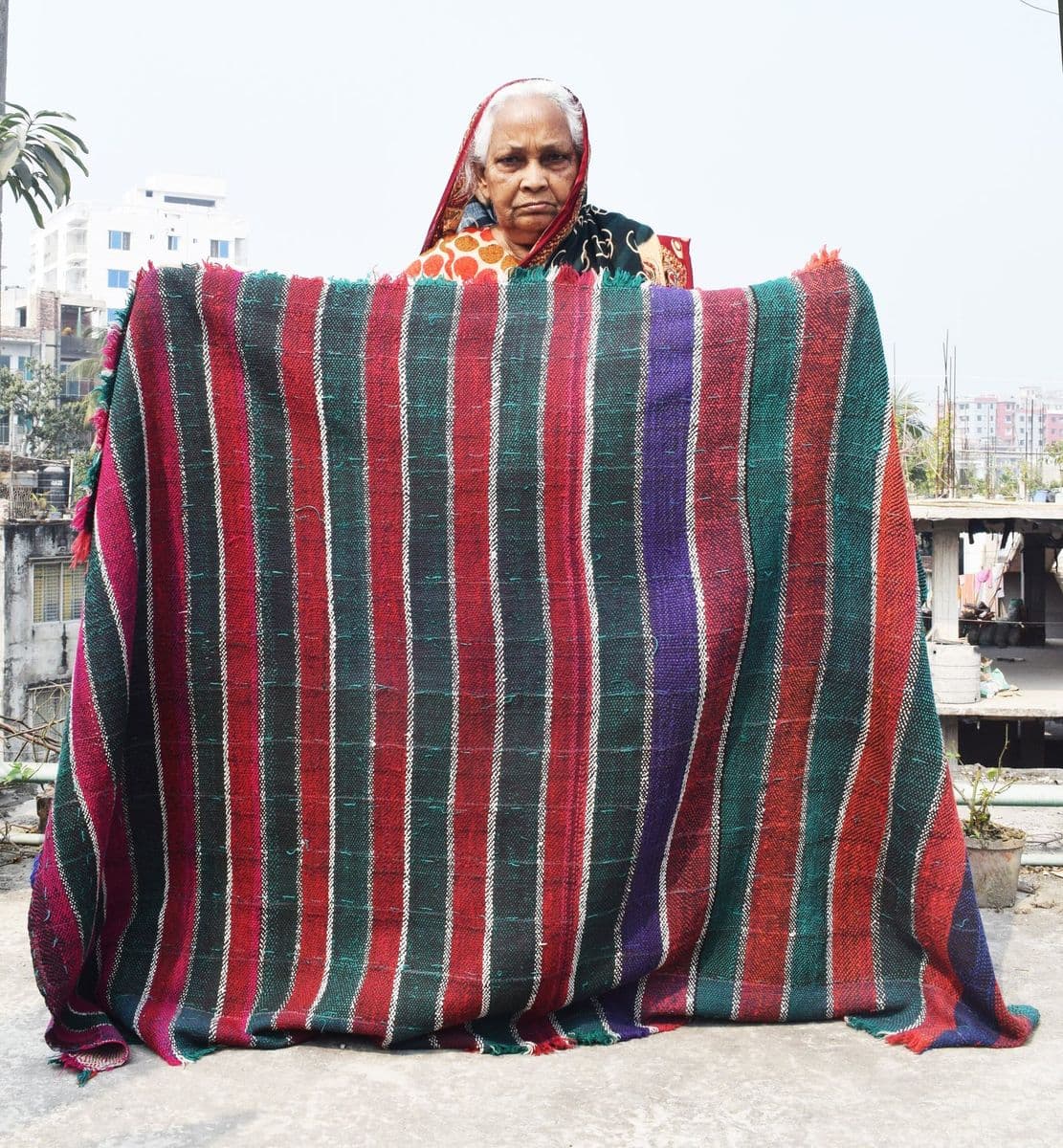
Shahera Khatun holding a large nakshi kantha she stitched, the scale at which a single household quilt is worked.
Shahera Khatun holding a large nakshi kantha she stitched, the scale at which a single household quilt is worked.Anup Sadi, CC BY-SA 4.0, via Wikimedia Commons

তাৎপর্য Significance

Why this, and not something else

Everything about kantha is an argument against waste. The cloth is old, the thread is pulled from the cloth, the stitch is the simplest one there is, and the finished object is a bedcover made entirely out of things that had stopped being useful. It is the only Bengali art form in which the medium is literally exhaustion — the point at which a sari stops being wearable is the point at which the kantha begins.

The second thing is the surface. Because four or five layers are quilted together with a running stitch worked freehand, the cloth puckers into a fine, irregular ripple that no machine reproduces and no two makers produce identically. You can identify a hand kantha by touch alone. In the festival, kantha appears as the good sari — the kantha-stitch silk that women buy for Durga Puja and keep for years — and as pandal cladding, where whole interiors are hung with quilts. Underneath both is the older meaning: that a woman with no property, no literacy and no audience made a large, slow, narrative object for her own household, and it survived her.

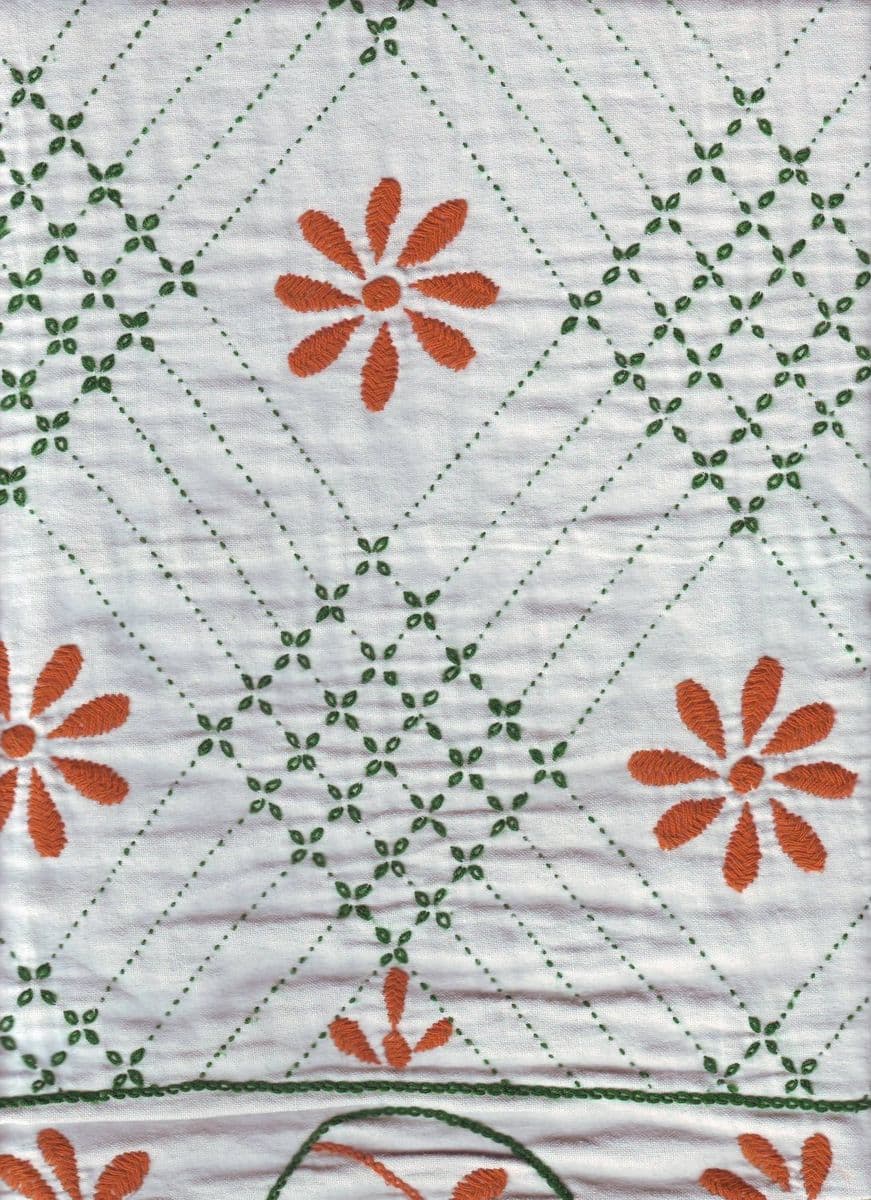
A flower motif in contemporary nakshi kantha, worked freehand without a frame or a drawn design.
A flower motif in contemporary nakshi kantha, worked freehand without a frame or a drawn design.A junaid alam khan, released into the public domain, via Wikimedia Commons

কীভাবে How it is made

The work itself

The base is purono kapor, old cloth: layers of worn sari or dhoti, smoothed and basted flat without a frame or hoop. The working stitch is the run or kantha phor, a plain running stitch, worked in rows across the whole ground; it is the rows of running stitch across the layers, not the motifs, that produce the characteristic rippled surface. Thread was traditionally drawn from the coloured borders of the same saris, which is why old kanthas are worked in a limited palette of red, black, blue and yellow. Composition is built from the centre out: the pankhuri or lotus medallion at the middle, corner motifs, a border, and the field filled with figures. Variants use lohori, the wave stitch, and lik or anarasi darning, plus satin, cross and back stitch on later commercial work. The types are named by use — lep and sujni for quilts, baiton for wrapping books, arshilata for a mirror or comb, durjani or thalposh as covers, rumal as a handkerchief.

কাঁথাKantha
A quilt made by layering worn cloth and joining it with running stitch; also the stitch and the whole tradition.
নকশি কাঁথাNakshi kantha
Patterned kantha. The compound entered general use after Jasimuddin's 1929 poem Nakshi Kanthar Math.
কাঁথা ফোঁড়Kantha phor / run
The plain running stitch that is the whole basis of the craft; the rows of it produce the characteristic rippled surface.
লহরিLohori
The wave stitch, worked in undulating lines, one of the named variant fills used alongside plain running stitch.
সুজনি / লেপSujni / lep
Kantha types named by use: the spread or bedcover, and the thicker padded quilt.
আরশিলতাArshilata
A narrow kantha envelope for a mirror or comb; one of the small domestic forms now rarely made.
বৈঠনBaiton
A square kantha for wrapping books or valuables, usually with an elaborate lotus at the centre.
কলকাKalka
The paisley or mango motif, one of the standard elements alongside the lotus, the tree of life, fish and the sun and moon.


কাহিনি The stories

What people tell each other about it

The poem that named the craft

In 1929 Jasimuddin published Nakshi Kanthar Math, a long narrative poem set in rural East Bengal, in which the heroine, Rupai's wife, stitches the story of their life into a quilt and, dying, leaves it on his grave. The poem was a phenomenon and is still taught. The compound nakshi kantha — patterned kantha — came into general Bengali use from it. Women had been making decorated quilts for centuries without a collective name for what they were doing; a male poet writing about one of them supplied the word, and the word is now on a geographical indication certificate.

A craft market in the 1980s

Shamlu Dudeja, a mathematics teacher and textbook author in Kolkata, saw women at a craft market in the 1980s using the kantha stitch to make wall hangings, and started buying and placing their work. Demand grew faster than supply, and she began organising training and payment for women in rural Bengal who had no other cash income. The enterprise she built, SHE — Self Help Enterprise — was running informally from about 1990 and was registered in 2003. It now reports associations with more than eighty thousand women artisans. Nearly every kantha sari sold in India today descends from that reorganisation.

Reading a quilt you were not meant to read

Old household kanthas are legible in a way commercial ones are not, because the maker was not designing for a buyer. Museum pieces from Jessore, Faridpur and Birbhum carry lotuses and trees of life alongside things nobody would put on a product: a steamer, a pair of scissors, a British soldier, a bicycle, a European chair, a wedding procession with named participants. The layout is almost always the same — a lotus medallion at the centre, motifs in the four corners, and the field filled in as the maker went. It is an unsigned, undated, first-person record of rural Bengali life, made by women who were rarely taught to write.

দেখুন Watch

Kantha KathaRural Craft & Cultural Hubs of BengalProduced for the West Bengal government's craft hubs programme; follows the Birbhum and Nadia stitching clusters and the women who work in them.
Kantha Embroidery: Craft Documentary, KolkataVanshika AggarwalA short craft documentary that shows the stitch and the commercial workshop chain rather than the finished retail product.

এখন Now

What state it is in

Kantha is commercially the healthiest of Bengal's crafts and socially the most compromised. West Bengal's GI registration for Nakshi Kantha dates from 2008; Bangladesh protected Jamalpur Nakshikantha in 2024. Tens of thousands of rural women stitch for it — SHE reports over eighty thousand associated artisans, other estimates around thirty thousand actively employed — mostly in Birbhum, Murshidabad, Nadia and Bolpur. Almost all of it is now embroidery on new silk or cotton for saris, dupattas and furnishings, not quilting of old cloth, and almost all of it is piecework. Machine-embroidered imitations undercut the market openly, and the surface ripple is the only reliable way to tell them apart. What has quietly disappeared is the original object: the household kantha, made slowly over years, for a person the maker knew by name. Museums have those. The trade does not make them any more.

যা দেবী সর্বভূতেষু বুদ্ধিরূপেণ সংস্থিতা। নমস্তস্যৈ নমস্তস্যৈ নমস্তস্যৈ নমো নমঃ॥

To the Goddess who abides in all beings as intelligence, salutation, salutation, salutation again and again.

Devi Mahatmya 5.20