Skip to content
All art forms

Performance

বায়োস্কোপ

Bioscope (The Peep-Show Box)

Bengal and across South Asia; the Indian form of the European raree show, 19th to mid-20th century

Where it stands

Endangered

No reliably documented living hereditary practitioner in West Bengal; see the Gurusaday Museum, Joka, and the Daricha Foundation archive, and the 2006 documentary The Bioscopewallah

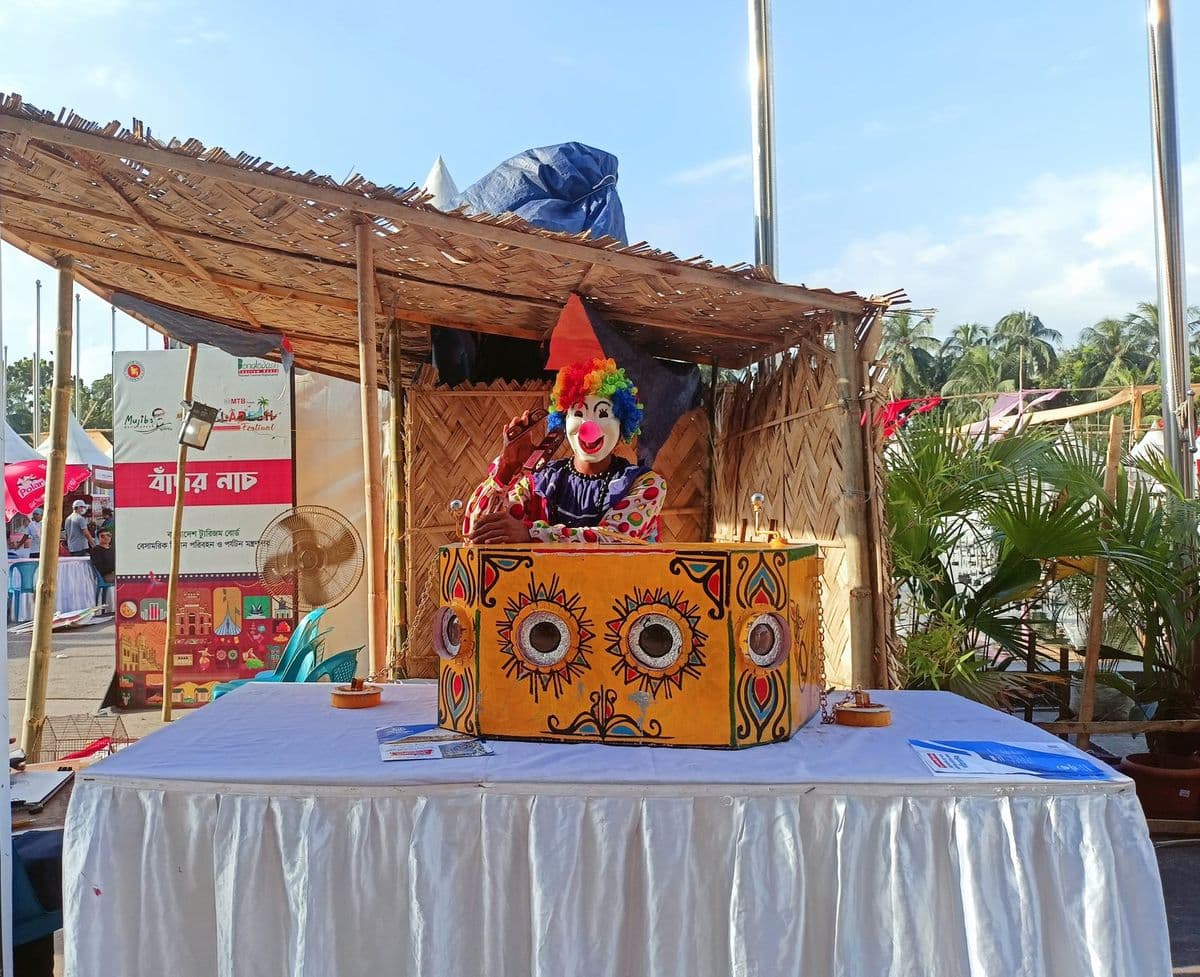
A bioscope box in rural Bengal, 2023: the painted cabinet, the eyeholes at child height, and the crank on top.

A bioscope box in rural Bengal, 2023: the painted cabinet, the eyeholes at child height, and the crank on top.Frameofashik, CC BY-SA 4.0, via Wikimedia Commons

A painted wooden box on a shoulder strap, a row of round glass eyeholes, a hand crank, and a reel of pictures inside. The bioscope-wala walked into a fairground in bright motley, set his box down, and cranked the reel while singing a rhymed commentary, the Taj Mahal, the Kumbh Mela, a king, a war, and children queued to press their eyes against the glass and see somewhere else. It was the first moving image most Bengali villagers ever saw, and it was a direct forerunner of cinema, which then destroyed it. It survives now only in memory, in a handful of documented last practitioners, and as a motif in pandals that stage it like a funeral.

ইতিহাস History

Where it came from

The word bioscope is Greek by way of English — bios, life, and skopeein, to look — and it was coined by Granville Penn in a Christian tract of 1812 to mean a measure of human life. Cinema repurposed it. In Britain, Charles Urban sold Bioscope-branded cameras and projectors from about 1905, and the trade weekly The Bioscope ran from 1908 to 1932; in South Africa the word still means cinema. In India it took a different and more durable form.

The first film shows in the subcontinent were in 1896, including one in Calcutta, and within a few years the term bioscope had attached itself both to the projected film and to a portable, hand-cranked viewing box that a man could carry on his shoulder or push on a cart. That box is the Indian bioscope: a painted wooden cabinet with a row of round glass eyeholes, a reel of images inside, a crank on top, and frequently a gramophone bolted on for accompaniment. Several children watched at once. The showman turned the handle and sang or spoke a rhymed commentary over the pictures — the Taj Mahal, the Kumbh Mela, a king, a war, a hanging, a foreign city.

Its ancestry is the European raree show or peep show, which reached Calcutta in the nineteenth century and was absorbed and remade. Its descendants are the travelling cinemas, the tent bioscopes, and finally the Bengali film industry itself. Calcutta was the pivot: the Royal Bioscope Company, founded by Hiralal Sen in 1898, was India's first, and Jamshedji Framji Madan built the country's first exhibition chain out of the same city.

What killed the box was the thing it prefigured. Cinema halls, then television, then video, then the phone, each removed a layer of its audience. The form survived in India far longer than in Europe or North America because the fairground economy it depended on lasted longer, and it survived in Bengal as a word and a memory long after it stopped being a trade.


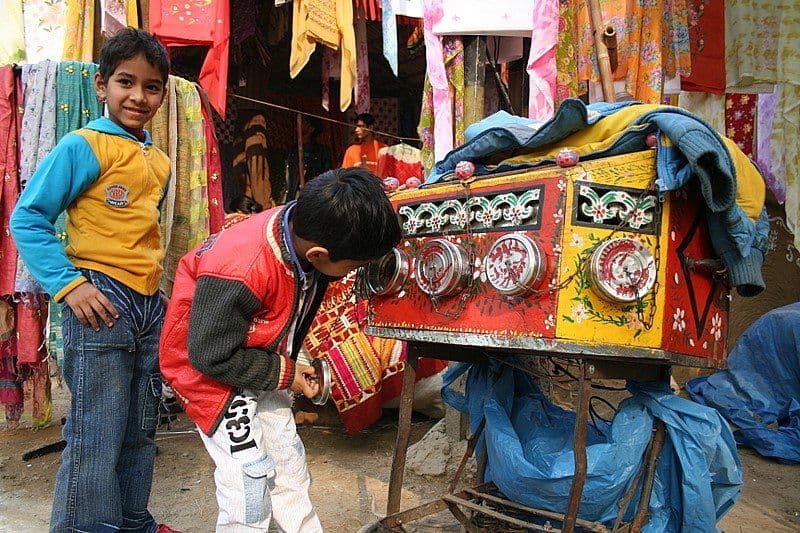
An Indian bioscope at a fair: several children watch at once through separate lenses while the showman narrates.
An Indian bioscope at a fair: several children watch at once through separate lenses while the showman narrates.Ramesh Lalwani, CC BY 2.0, via Wikimedia Commons

সংস্কৃতি Culture

Who does it, and who used to

The bioscope-wala was an itinerant showman, usually poor, usually Muslim or from a low-caste artisan background, working the fairs and the festival grounds and, in the cities, the park and the street corner. He was a one-man operation: he owned the box, painted it, cut and spliced the reel, maintained the mechanism, and did the voice. The commentary was the art. A good bioscope-wala sang the pictures in rhymed doggerel with a fixed metre, and the children paid for the performance as much as the images.

The audience was children, and the price was small change — one rupee a head in Kolkata within living memory. This was the first moving image that most Bengali villagers ever saw, and for a generation it was the only one, which is why the word bioscope became the ordinary Bengali word for cinema and is still used that way by older speakers.

At Durga Puja the bioscope belonged to the mela and the pandal ground, where it competed with the puppet stage, the jalebi fryer and the balloon seller. Its present festival role is sharper and stranger: pandals now stage bioscopes as exhibits — a painted box on a plinth, or a whole pandal built as one — so that visitors queue to look through the eyeholes at an art form that died within their parents' lifetimes. It is memorialised in the very institution that replaced it.

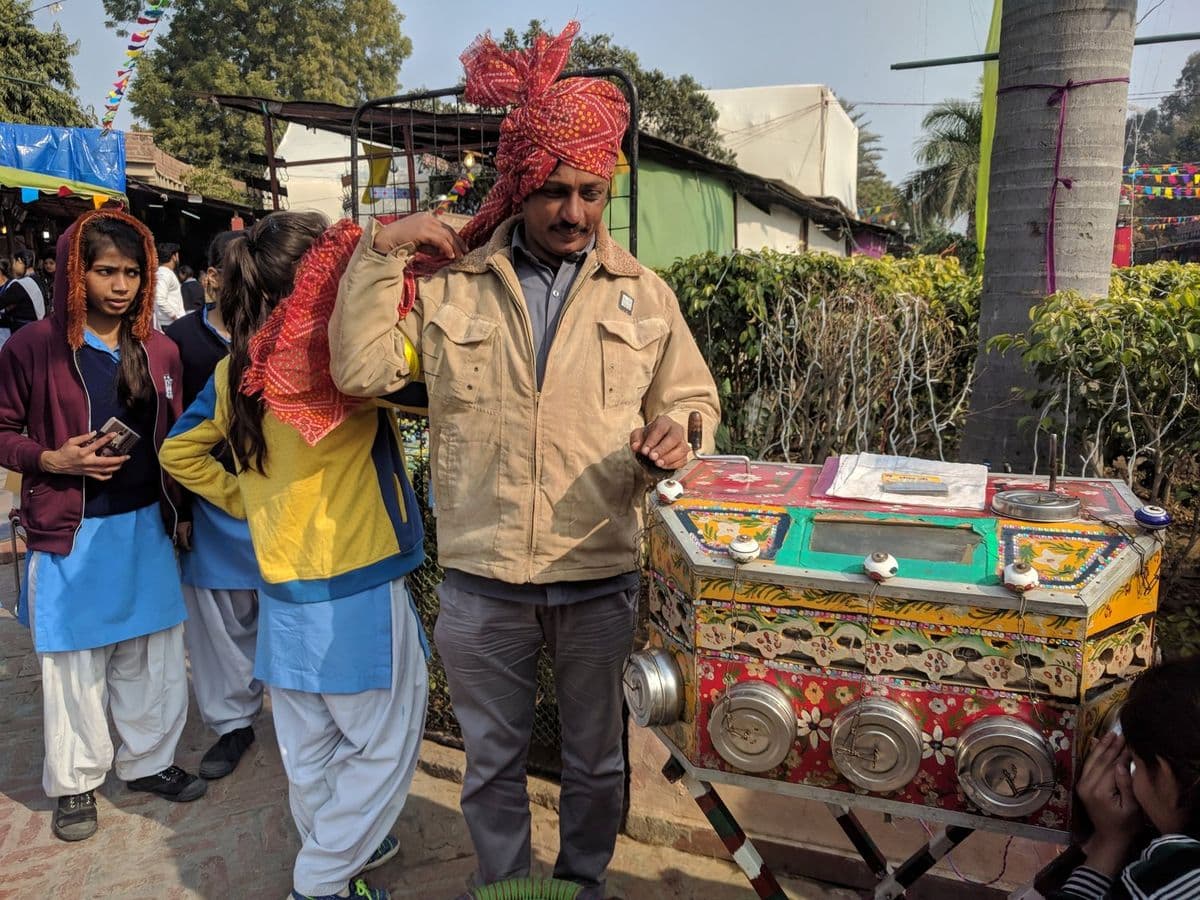
A surviving bioscope at Dilli Haat in 2019, now worked as a heritage demonstration rather than as a livelihood.
A surviving bioscope at Dilli Haat in 2019, now worked as a heritage demonstration rather than as a livelihood.Ramesh Lalwani, CC BY 2.0, via Wikimedia Commons

তাৎপর্য Significance

Why this, and not something else

The bioscope is the missing rung between the scroll and the screen. A patua unrolls a painted scroll frame by frame and sings the story; a bioscope-wala cranks a reel of pictures past a lens and sings the story; a projector runs film past a lamp and a playback singer sings the story. The technology changes and the job does not. Bengal invented none of these in isolation, but it is one of the few places where you can still see all three next to each other in the same week of the same festival.

It also documents something about how images travelled. Before photography was cheap and long before television, the bioscope was how a child in a Bengali village saw the Taj Mahal, a steamship, a European street, a coronation. It was a delivery system for the wider world, operated by a man with a hand crank and a good singing voice, paid for in coins.

Its afterlife is the honest measure of what happened. Bioscope is now a Bengali word for cinema, a film title, a pandal theme, and a museum object, and there are perhaps a handful of working practitioners left in the whole country.

কীভাবে How it is made

The work itself

A wooden cabinet, painted in bright figurative panels, carried on a shoulder strap or mounted on a hand cart, with four or more round lenses set in one face at child height. Inside, a long strip of images — chromolithographs, cut-up film stills, postcards, printed photographs — is wound between two spools. A crank on the top turns the take-up spool through a simple gear, dragging the strip past the lenses; some boxes add a shutter or a rotating drum to break the motion into frames. Lighting is usually daylight through a translucent top panel or a mirror. Many boxes carry a gramophone or, later, a small speaker, so the pictures have music; the showman's own sung commentary, in rhymed couplets to a fixed metre, is the primary soundtrack. Everything is repairable by hand, which is why individual machines survived a century of touring. The Bengali word for the whole apparatus, the trade and eventually the cinema itself is simply bioscope.

বায়োস্কোপBioscope
The hand-cranked peep-show box; also, in ordinary older Bengali, the word for cinema itself.
বায়োস্কোপওয়ালাBioscope-wala
The itinerant showman who owns the box, cranks it, and sings the rhymed commentary over the pictures.
মেলাMela
The fair, the bioscope's economic habitat: the ground beside a village puja where the box was set down and the children queued.
পিপ-শোRaree show
The European peep show, the box's nineteenth-century ancestor, which reached Calcutta and was absorbed and remade.
হাতলChaka / handle
The crank on top of the box that drags the picture strip past the lenses; the speed of the story is the speed of the hand.
রয়্যাল বায়োস্কোপ কোম্পানিRoyal Bioscope Company
India's first bioscope company, founded in Calcutta by Hiralal Sen in 1898.

কাহিনি The stories

What people tell each other about it

Salim Baba

Mohammed Salim of Kolkata began cranking a bioscope at twelve, taught by his father, and was still doing it in his late fifties more than forty years later. His machine was a hundred-year-old Japanese projector on a hand-driven cart; it had come to him without sound, and he worked out how to add audio himself after watching how cinema halls matched sound to lip movement. He showed three or four minutes of Hindi film songs, dances and fights for a rupee a head, and travelled with a son who had no interest in inheriting any of it. Tim Sternberg and Francisco Bello's short film about him, Salim Baba, was nominated for an Academy Award in 2008.

Where the word comes from

Granville Penn coined bioscope in 1812, in a Christian tract, to mean a general measure of human life. Cinema took the word back. Charles Urban sold Bioscope-branded cameras and projectors in Britain from about 1905, and the trade paper The Bioscope ran from 1908 to 1932. In South Africa the word simply became the word for cinema, and in Bengal it did the same: older Bengali speakers still say bioscope where a younger one says cinema. The peep-show box that carried the name into Indian villages is the reason, and it has outlived the box by three generations.

The first bioscope company in India

Hiralal Sen founded the Royal Bioscope Company in Calcutta in 1898, the first of its kind in India, filming stage scenes from Classic Theatre productions and showing them between live acts. Jamshedji Framji Madan built the subcontinent's first real exhibition chain out of the same city. So Calcutta held, simultaneously, the beginning of Indian film exhibition and the peak of the hand-cranked box that film exhibition would destroy, and both were called by the same word. The bioscope-wala on the fairground and the Royal Bioscope Company in the city were, for about two decades, in the same trade.

দেখুন Watch

Chalta Phirta Cinema: Bioscope (full documentary)Jatin PatialA short documentary on the surviving Indian bioscope trade, filmed with a working showman and his machine.
Bioscope magic from olden days: watching movies old style at Suraj KundWildFilmsIndiaArchive-style footage of a bioscope being cranked at a fair, showing the box, the eyeholes and the commentary in use.

এখন Now

What state it is in

The trade has effectively ended. The best documented of the last practitioners is Mohammed Salim of Kolkata, who started at twelve under his father, worked the city's streets for more than forty years, and pushed a hand cart carrying a hundred-year-old projector of Japanese make — he had added sound himself after studying how cinema halls synchronised it. He showed three- and four-minute cuts of Hindi film songs, dances and fights, at a rupee a viewer, and travelled with a son who wanted nothing to do with it. Tim Sternberg and Francisco Bello's short documentary about him, Salim Baba, was nominated for an Academy Award in 2008. Isolated bioscope-walas still appear at Dilli Haat, Surajkund and a few Bengali fairs, mostly as heritage demonstration rather than livelihood. The form now survives chiefly as vocabulary, as film titles such as Bioscopewala and Open Tee Bioscope, and as a Durga Puja pandal theme staged with something close to grief.

যা দেবী সর্বভূতেষু বুদ্ধিরূপেণ সংস্থিতা। নমস্তস্যৈ নমস্তস্যৈ নমস্তস্যৈ নমো নমঃ॥

To the Goddess who abides in all beings as intelligence, salutation, salutation, salutation again and again.

Devi Mahatmya 5.20