

Skip to content
All art forms

Painting

চালচিত্র

Chalchitra (Painted Backdrop)

Bengal, documented for roughly three centuries; Nabadwip, Krishnanagar, Kolkata

Where it stands

Endangered

Reba Pal, Krishnanagar (Nadia), in her eighties and still painting chalchitra; also the Chitrataru patua cooperative, Naya, Pingla

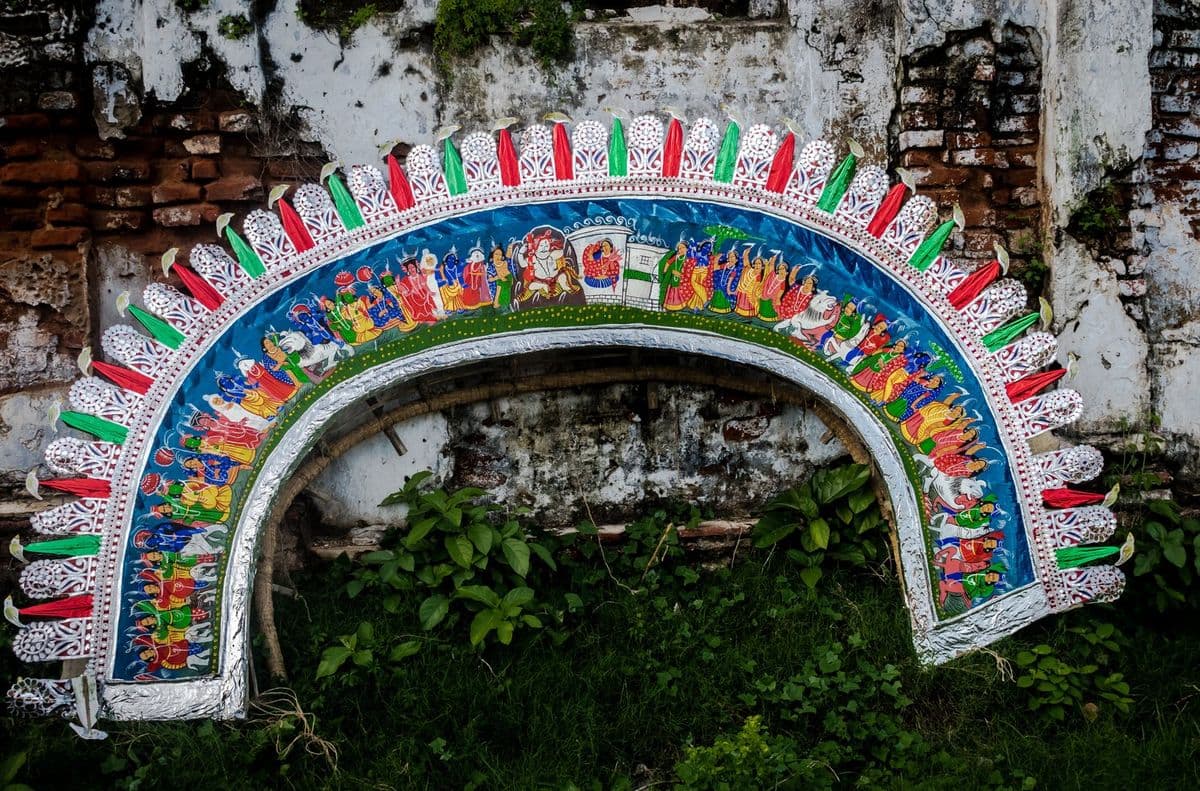
A finished chalchitra arch propped against a whitewashed wall, its narrative registers framed in silver foil and coloured pith petals.

A finished chalchitra arch propped against a whitewashed wall, its narrative registers framed in silver foil and coloured pith petals.TAPAS KUMAR HALDER, via Wikimedia Commons

Behind the traditional Durga group rises a great painted arch, the chalchitra, from chal, a covering or roof. It was never mere decoration. Its curve gives the five-figure ek-chala composition its proportion and its ceiling, and its horizontal registers carry the story, Shiva and Durga, the ten avatars, Rama and Ravana, the whole Shakta pantheon painted in chalk white, indigo, red ochre and lampblack on cloth stretched over bamboo. It is painted by patuas, not by the idol-maker, which means the backdrop is a scroll painting that has become architecture. For decades printed vinyl replaced it and the painting families nearly vanished. Heritage pujas have begun, belatedly, to commission the real thing again.

ইতিহাস History

Where it came from

Chal (চাল) means a covering or a roof. The chalchitra is the painted screen that rises behind and over the Durga group in the classical ekchala image — a semicircular or arched board, sometimes eight feet across, carrying scenes in horizontal registers. It is also called Durga-chal, Devi-chal or simply chali.

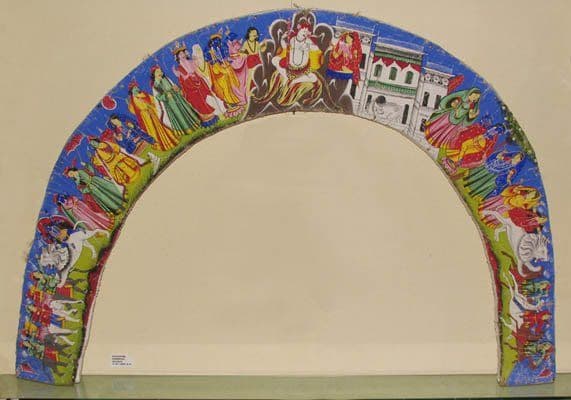
It began as a solution to a compositional problem. Five figures of very different heights standing side by side need a top edge, and the chal supplied one, following the roofline of a Bengali temple. Three regional types are distinguished. Bangla chal follows the curved do-chala thatch roofline and stretches across all five figures. Math-chouri or mathchala chal follows the tapering spire of a math temple. Markini chal — the rounded, Victorian-influenced arch — is the commonest form today and is the one visitors usually mean when they say chalchitra.

Dating is contested and worth stating carefully. Popular writing and the Wikipedia entry give the tradition an antiquity of about 1,200 years. That figure has no supporting evidence and should be treated as unverified. The defensible figure is roughly three hundred years, which is what documented examples — notably from the Shakta Ras at Nabadwip and from the bonedi baris of Kolkata and Krishnanagar — will support, and which matches the age of the ekchala image itself.

The painters were never the sculptors. Chalchitra was and is the work of Patua or Chitrakar hands, the same scroll-painting community that makes patachitra, and the craft is formally classified as a branch of Bengal Patachitra. A chalchitra is a pata that happens to be architectural.

A mathchala-type chalchitra from the Gurusaday Museum collection, Shiva and Ganesha at the crown above descending narrative registers.
A mathchala-type chalchitra from the Gurusaday Museum collection, Shiva and Ganesha at the crown above descending narrative registers.Shri Gurusaday Dutt, via Wikimedia Commons

সংস্কৃতি Culture

Who does it, and who used to

The division of labour is the interesting part. A puja that wants a genuine hand-painted chal must hire two separate castes: a Pal family to build and paint the image, and a Chitrakar to paint the backdrop. Many of the Chitrakars now doing this work at Naya in Pingla are Muslim by faith and bear the Chitrakar title, and they paint the Shakta pantheon and the Shiva–Durga narrative for Hindu household pujas. That arrangement has been normal in Bengal for centuries and is neither remarked on nor concealed.

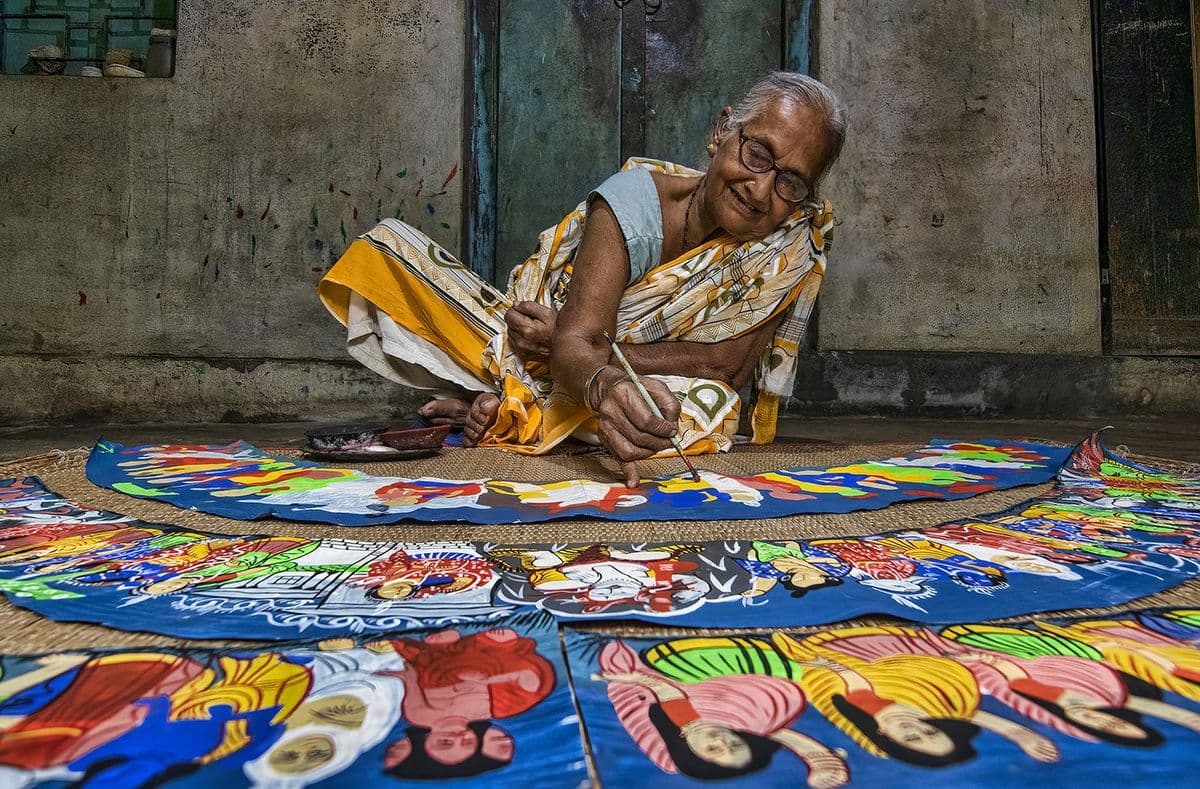
Within Chitrakar families the work is not restricted by gender. Women paint chalchitra, sign it and are paid for it, which is not true of idol-making. The single most-photographed living chalchitra painter is an elderly woman in Krishnanagar — Reba Pal is the name most often given in the press — who has been repeatedly filmed sitting on her floor painting long curved strips, and who is routinely described as one of the last of the traditional hands.

The audience has changed more than the practice. For most of its life the chalchitra was invisible as art: it was the back of the image, a thing you looked past. Theme pujas inverted that. Since about 2000, committees have commissioned Chitrakars to extend chalchitra logic across an entire pandal — walls, ceiling, approach corridor — so that a visitor walks inside the backdrop instead of standing in front of it. The patuas' fee went up; the object disappeared.

An elderly Krishnanagar painter at work on the floor, filling long curved chalchitra strips with flat colour by hand.
An elderly Krishnanagar painter at work on the floor, filling long curved chalchitra strips with flat colour by hand.Iamsantanubose, via Wikimedia Commons

তাৎপর্য Significance

Why this, and not something else

The chalchitra is the caption of the Durga image. The clay figures show one instant — the spear going in — and say nothing about why. The painted arch supplies the rest: the Shiva–Durga marriage, the ten avatars, Rama and Ravana, the Dasha Mahavidya, scenes from the Chandi, sometimes Krishna's life along the lower registers. A literate viewer reads the arch left to right and gets the whole theology; an illiterate one gets it as pictures, which was the point.

It also does something structural. The arch declares that these five figures are one family under one roof. Break the arch, as Gopeshwar Pal did in 1938, and you get five separate deities on five platforms — which is exactly what happened to the meaning as well as to the sculpture. The panch-chala Durga is a goddess with attendants. The ekchala Durga under her painted chal is a married daughter who has come home with her children, and the roof over her is the roof of her parents' house.

That is why heritage pujas insist on it and why its loss is not merely decorative.

কীভাবে How it is made

The work itself

A half-dome frame is built from split bamboo, sometimes with a shola core, and cloth or heavy paper is stretched over it and stitched down. The surface is sized and primed with khori (খড়ি), chalk dust bound in gum, until it is white and slightly absorbent. The drawing is laid in with charcoal or a thin brush, freehand, in registers separated by ruled bands. Traditional pigment is entirely local: khori for white, indigo (নীল) for blue, geru (গেরু) or red ochre and sindur for red, halud (হলুদ, turmeric) for yellow, kalo (lampblack from a soot lamp) for black, and burnt earth for browns. The binder is bel-fruit gum or tamarind-seed gum. Brushes are squirrel or goat hair set in a quill. Outlines go on last, in a single swelling and tapering stroke of black that models volume without shading — the same contour discipline as patachitra and Kalighat pat. The finished arch is edged with foil, and green and red shola or paper petals are set around the rim so the whole thing reads as a temple roofline from the front of the pandal. Most contemporary chals are printed or tinsel; the hand-painted version is now a premium commission.

চালchal
A covering or roof; the arched board behind the Durga group takes its name from the roofline it imitates.
একচালাekchala
The classical image in which all five figures stand under a single arch, with the chalchitra as its painted face.
মার্কিনি চালMarkini chal
The rounded, Victorian-influenced arch, the commonest chalchitra type today.
মঠচালাmathchala
A chal following the tapering spire of a math temple rather than a thatched roofline.
খড়িkhori
Chalk dust, used both as the white primer on the cloth and as the white pigment.
গেরুgeru
Red ochre, the standard earth red of the chalchitra palette.
দশমহাবিদ্যাDasha Mahavidya
The ten Tantric goddesses frequently ranged across the upper registers of a chalchitra.
চিত্রকরChitrakar
Painter — the caste title of the patua community who paint chalchitra, distinct from the Pal potters who build the idol.

কাহিনি The stories

What people tell each other about it

The old woman with the long strips

The most widely reproduced image of living chalchitra practice shows an elderly woman in spectacles sitting on the floor of a bare room in Krishnanagar, a saucer of pigment beside her, painting a long curved strip laid flat on a mat, with three more finished strips drying around her. She is usually identified in the press as Reba Pal, in her eighties, and is described in almost every account as one of the last traditional chalchitra painters. The photograph is doing two jobs at once: it records a craft, and it records that the craft is down to individuals who can be counted.

The twelve-hundred-year problem

Chalchitra is routinely described, including on Wikipedia, as a tradition about 1,200 years old. No source supports that. There is no dated chalchitra, no inscription, no textual reference and no surviving example from anything close to that period, and the ekchala image the chal was invented to crown is itself only about three centuries old. The defensible claim is roughly 300 years, supported by documented examples from Nabadwip's Shakta Ras and the Kolkata bonedi baris. The longer figure appears to be an accretion of repetition. Where it matters, this page uses the shorter one.

A backdrop that swallowed the pandal

From about 2000, Kolkata's theme pujas began hiring patua painters not to make a chalchitra but to paint everything. At Naya in Pingla the Chitrataru cooperative now takes commissions to cover pandal walls, ceilings and approach corridors in pata work, so that the visitor walks through the painting rather than looking at it. The economics improved sharply for the painters. The object did not survive the change: in a pandal where every surface is painted, the one thing that is often missing is an actual chal behind the goddess.

দেখুন Watch

Chalchitra: How This Old Lady Is Keeping This Ancient Art Heritage Alive | Durga Puja 2024The Indian ExpressThe Indian Express filmed an elderly Krishnanagar chalchitra painter at work, which is close to the only moving record of the traditional hand method.
Faces of Durga Puja | Episode 3 | Somoyer Chalchitra | a hoichoi DocumentaryHoichoiAn episode of hoichoi's Faces of Durga Puja documentary series that goes into the workshops where chalchitra is made.
Traditional Durga Chalchitra Painting by Sri Arka Das 2020 | দুর্গা চালচিত্রSri Arka DasA painter's own full record of making a traditional Durga chalchitra, useful for seeing the register layout and the contour stroke.

এখন Now

What state it is in

For most of the twentieth century the hand-painted chalchitra was in free fall. Mass-printed cloth backdrops and tinsel arches were cheaper, arrived ready-made and did not require finding a Chitrakar, and the number of families still painting them fell to a handful. Several districts lost the craft entirely. It has partly come back, and for a commercial reason rather than a sentimental one. The sabeki turn in Kolkata's competitive pujas made a hand-painted chal a selling point, and heritage-conscious bonedi baris in Kolkata, Krishnanagar and Nabadwip began ordering them again. The Chitrataru cooperative at Naya in Pingla now takes chalchitra commissions alongside scrolls and full pandal interiors, which has given younger patuas a reason to learn the format. Named practitioners remain very few. Reba Pal of Krishnanagar, in her eighties, is the most frequently cited; the Naya patuas supply most of the rest. A hand-painted arch for a life-size group takes weeks and is priced accordingly, so the realistic market is a few dozen commissions a year across all of West Bengal.

যা দেবী সর্বভূতেষু বুদ্ধিরূপেণ সংস্থিতা। নমস্তস্যৈ নমস্তস্যৈ নমস্তস্যৈ নমো নমঃ॥

To the Goddess who abides in all beings as intelligence, salutation, salutation, salutation again and again.

Devi Mahatmya 5.20