

Skip to content
All art forms

Light

চন্দননগরের আলোকসজ্জা

Chandannagar Illumination

Chandannagar (Chandernagore), a former French colony on the Hooghly; from the 19th century

Where it stands

Evolving

Babu Pal, Sukumar Biswas and Ashim De, Chandannagar; the Chandannagar Light Owners' Association and AALO, The Light Hub

Chandannagar lighting during Jagaddhatri Puja, 2016: flat bulb panels built as arches over a street rather than on a facade.

Chandannagar lighting during Jagaddhatri Puja, 2016: flat bulb panels built as arches over a street rather than on a facade.Kinjal bose 78, CC BY-SA 4.0, via Wikimedia Commons

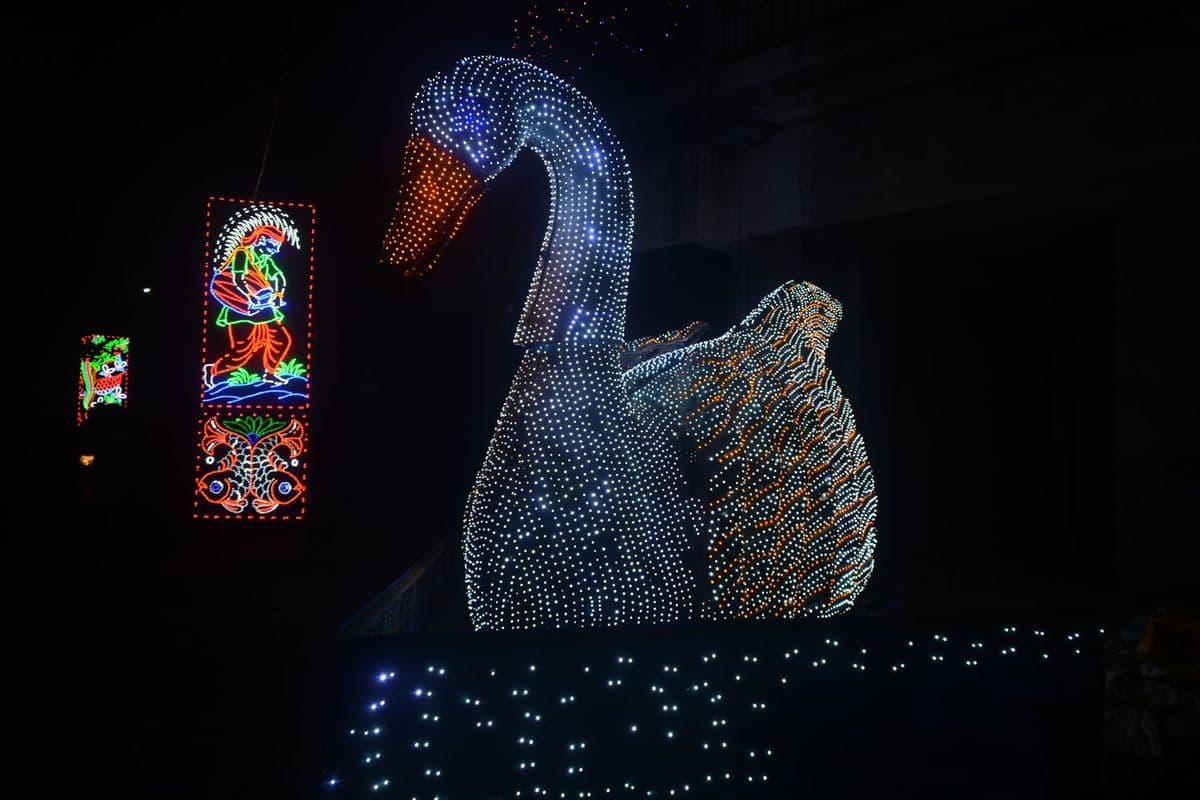
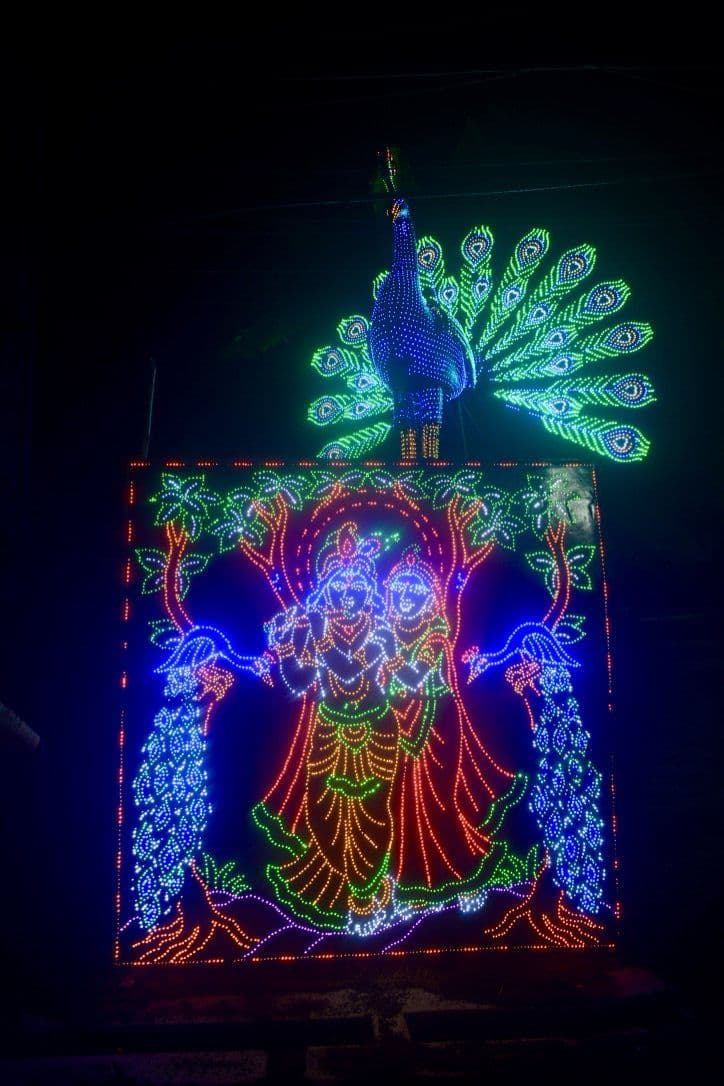
Chandannagar's light artisans invented moving pictures out of light bulbs. They build vast flat panels of thousands of tiny bulbs, each one wrapped by hand in coloured paper, and then sequence them with rotating drum-and-contact switches so that the image animates, a deer runs, a dancer turns, Durga's spear descends into Mahishasura. All of this was achieved mechanically, decades before any of it could be programmed. Sridhar Das, who began experimenting as a student in the early 1950s, turned festival lighting into an art form and in 2003 floated a seven-metre peacock boat made of 130,000 bulbs down the Thames. LEDs have since arrived, brighter and cheaper, and the craft is arguing with itself about what was lost.

ইতিহাস History

Where it came from

Chandannagar was a French possession on the west bank of the Hooghly from 1673 until it voted to join India in 1949, and its great festival is not Durga Puja but Jagaddhatri Puja, held a month later and said to have been introduced there by a local zamindar in the late eighteenth century. The illumination began as procession lighting. Before electricity reached the town, gas lamps were mounted on bamboo frames and carried with the goddess; when the supply arrived, the frames stayed and the lamps changed.

The person who turned that into an art form was Sridhar Das. He began as a schoolboy in the early 1950s, building his first display for a school Saraswati Puja out of barley tins and coloured cellophane, and he never studied past Class Eight; he learned electricity doing odd jobs at an electrician's shop. His father threw him out for giving up a mill job, and the family of his friend Bikash Ghosh kept him. In 1965 he made his first running lights for the Jagaddhatri Puja at Narua, using a flat wooden board and ten-foot arches. In 1968 he was hired by the Bidyalanka puja committee to write the word Bidyalanka in Bengali in 25-watt lamps strung on heavy wire and set underwater in a pond; the Boroline company commissioned the same trick for its brand name in 1969. During one demonstration a loose wire caught his finger and he was badly burnt on his hand and back. He was still recovering when he took the commission for the puja of the West Bengal chief minister Siddhartha Shankar Roy in 1970.

His mechanism was a wooden roller with copper contact strips — a rotating drum switch that closed circuits in sequence, animating an image made of thousands of bulbs. At the Festival of India in Moscow in 1985 he showed ten panels of twenty by twelve feet each; the Soviet organisers, assuming computer control, asked to keep a roller for a museum. He later worked in Ireland, in Los Angeles on an AIDS awareness display, and in London, where in 2003 he floated a seven-metre mayurpankhi, a peacock boat, down the Thames, carrying 130,000 tuni bulbs.

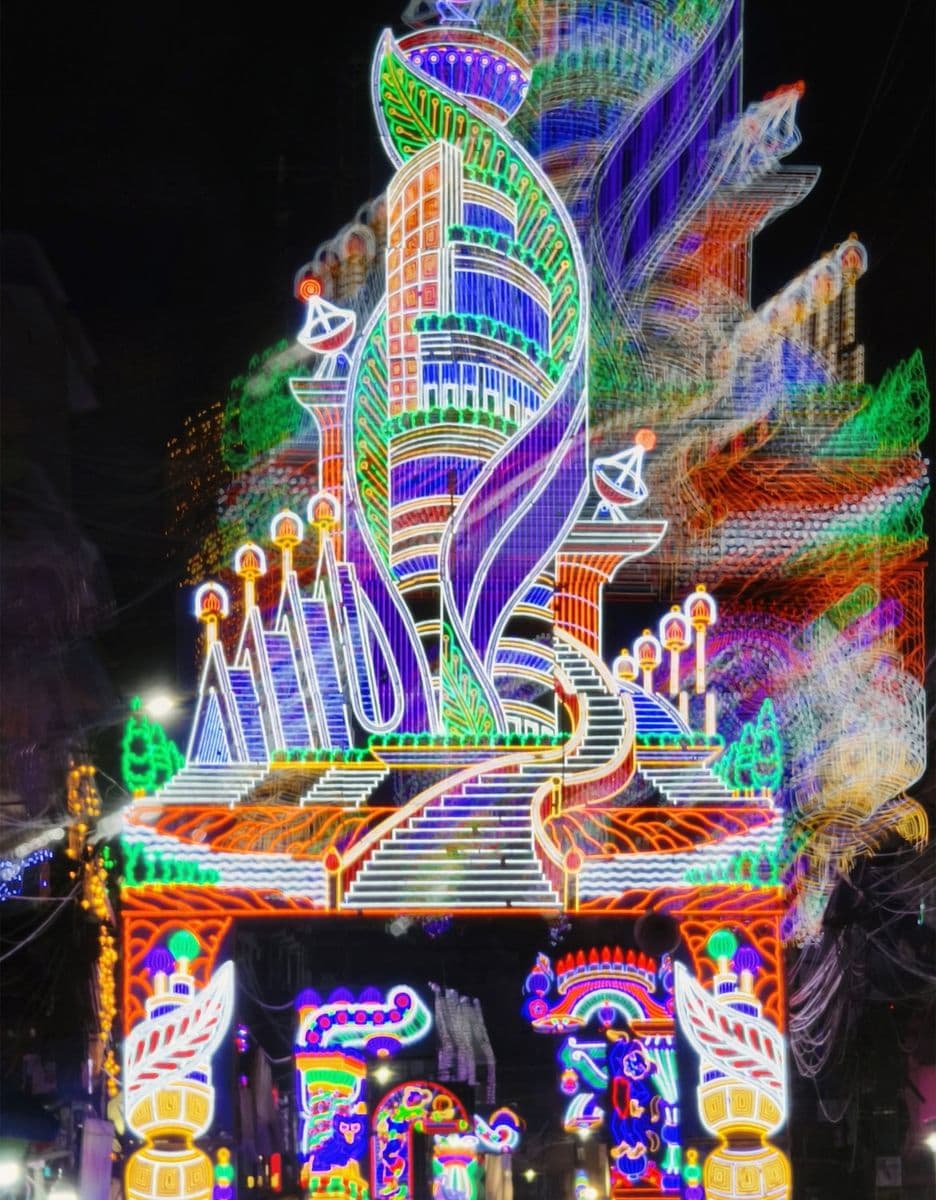
A Chandannagar light gate, 2024, with the figurative panel work that the town's firms build for pujas across India.
A Chandannagar light gate, 2024, with the figurative panel work that the town's firms build for pujas across India.Kaju59, CC BY-SA 4.0, via Wikimedia Commons

সংস্কৃতি Culture

Who does it, and who used to

The trade is organised as family firms, not as a caste guild, and it is one of the few Bengali crafts where the founding generation is documented by name and still argued about. Sridhar Das trained most of the men who now run it — Babu Pal, Sukumar Biswas, Dipendu Biswas, Pintu Das among them. Kashinath Neogy is credited with bringing LEDs into Chandannagar in 2005, though Ashim De is named elsewhere as having introduced them as early as 1988; the two claims have not been reconciled and both are repeated locally.

The work is seasonal and male, and it is dangerous in an ordinary way: men on bamboo scaffolding wiring live circuits above a crowd, in the rain. The unglamorous labour is done by women and children in households across the town, wrapping each miniature bulb by hand in coloured cellophane — the step that produces Chandannagar's particular saturated colour and that LEDs have made largely redundant. A single large panel can run to a hundred thousand bulbs or more, and the wrapping is paid by the piece.

The town's own rhythm is inverted from Kolkata's: Chandannagar's artisans spend Durga Puja lighting other people's pandals across Bengal, Mumbai, Delhi, Madhya Pradesh and Chhattisgarh, and come home to light their own Jagaddhatri Puja in November, where the competition between neighbourhood committees is fiercer than anything they do for hire.

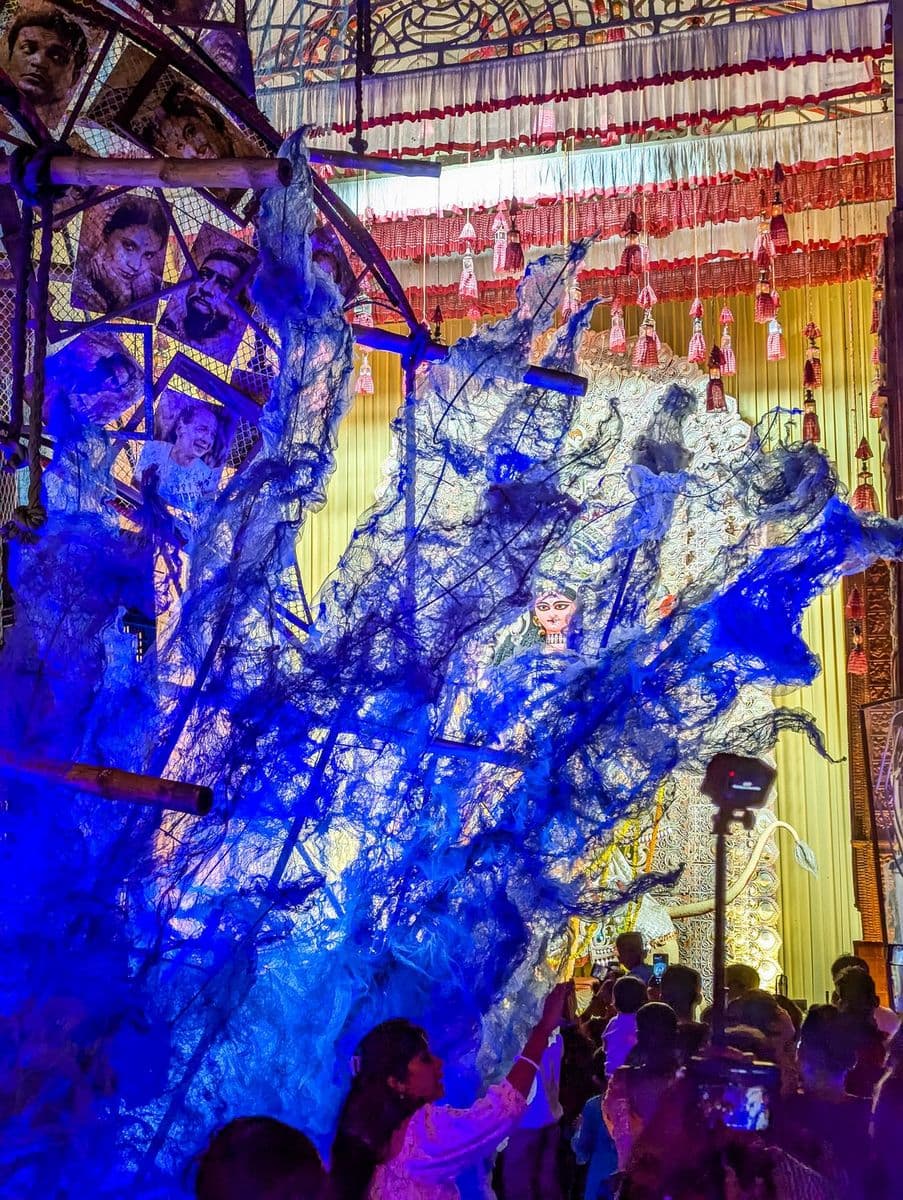
Jagaddhatri Puja at Chandannagar, 2024, the festival for which the town's own light artisans stay home and compete.
Jagaddhatri Puja at Chandannagar, 2024, the festival for which the town's own light artisans stay home and compete.Sourabh.biswas003, CC BY-SA 4.0, via Wikimedia Commons

তাৎপর্য Significance

Why this, and not something else

Chandannagar solved the problem of the moving image with a wooden roller and a lot of patience, and it did so in a small town on the Hooghly, decades before anything about it could be programmed. That is the whole point of the craft: a deer runs, a dancer turns, Durga's spear goes into Mahishasura, and the animation exists nowhere except in the timing of contacts closing on a rotating drum. It is folk engineering of a high order, and it was invented by people with no formal training in engineering.

It also does something specific for the festival. A pandal is a building that exists for five days; the light is what makes the street between the pandals part of the work. Chandannagar's gates and arches turn an entire road into a lit corridor, so that the walking — the parikrama itself — becomes the experience rather than the interval between experiences. Every Bengali who has queued on a wet October night has stood under a Chandannagar panel and watched a picture made of bulbs move, and has probably not known the name of anyone who made it.

A lit corridor in Chandannagar: the panels are designed to be walked under, making the street between pandals part of the work.
A lit corridor in Chandannagar: the panels are designed to be walked under, making the street between pandals part of the work.Kinjal bose 78, CC BY-SA 4.0, via Wikimedia Commons

কীভাবে How it is made

The work itself

The traditional unit is the tuni — a miniature 6.2-volt incandescent bulb, hand-wrapped in coloured cellophane or paper to fix its colour. Thousands are mounted on a flat frame of wood and bamboo to form a pixel grid, and grouped into circuits. Animation comes from the mechanical switch: a wooden cylinder or roller, turned slowly by a small motor, with strips of copper set into its surface that sweep past fixed brushes and close each circuit in turn. Change the pattern of copper on the drum and you change the animation. Frames are built as flat panels, as arches over roads, as gates (torons), and as free-standing tableaux. Since about 2005, LED strip and pixel modules with electronic controllers have displaced most of this: brighter, cheaper to run, programmable, and made largely in China. The vocabulary of composition has survived the change of lamp; the drum switches mostly have not.

আলোকসজ্জাAlokshajja
Illumination, light-dressing: the general Bengali term for the whole craft of festival lighting.
টুনি বাল্বTuni bulb
The miniature 6.2-volt incandescent lamp that is the pixel of a traditional Chandannagar panel, wrapped by hand in coloured paper.
তোরণToron
A lit gateway or arch built across a street, framing the approach to a pandal and turning the road itself into part of the display.
জগদ্ধাত্রী পুজোJagaddhatri Puja
Chandannagar's principal festival, a month after Durga Puja, for which the town's own artisans light the town.
আলোকশিল্পীAlok shilpi
Light artist: the term the Chandannagar makers use for themselves, as against electrician or contractor.
ময়ূরপঙ্খীMayurpankhi
The peacock-prowed pleasure barge of Bengali river iconography; the subject of Sridhar Das's 2003 Thames installation.

কাহিনি The stories

What people tell each other about it

Writing a word under water

In 1968 the Bidyalanka puja committee asked Sridhar Das for something nobody had seen. He shaped the word Bidyalanka in Bengali letters out of thick pliable wire, framed it with bamboo strips, fitted it with 25-watt lamps and sank it in a pond, so the word burned under the water. It worked well enough that the Boroline company hired him the next year to write its brand name the same way. During one demonstration a loose wire caught his finger and burnt through the skin; he fell backwards and burnt his back as well. He was still healing when the commission came for the chief minister Siddhartha Shankar Roy's puja in 1970.

The Russians wanted the roller

For the Festival of India in Moscow in 1985, Sridhar Das built ten illuminated panels, each twenty feet by twelve. The Soviet organisers watched the images animate and assumed there was a computer somewhere in the rig. When they were shown that the sequencing was done by a wooden cylinder with copper strips let into it, turning slowly against fixed contacts, they asked him to leave one behind for a museum. The machine was, by any fair account, a mechanical sequencer built by a man who had left school after Class Eight and learned wiring in an electrician's shop in a small town on the Hooghly.

A peacock boat on the Thames

In 2003 Sridhar Das took a mayurpankhi — the ornamental peacock barge of Bengali river iconography — to London and floated it on the Thames for the river festival. It was about seven metres long and carried roughly 130,000 tuni bulbs, the miniature 6.2-volt lamps that Chandannagar's households wrap by hand in coloured paper. It remains the most-cited single object in the town's history, partly because it is the one time the craft travelled under its own name rather than as anonymous decoration behind somebody else's goddess.

দেখুন Watch

COVID Impact on the Famous Lighting Art Industry of Chandannagar - Sri Babu PalShoubhik's Creative SpaceA sustained interview with Babu Pal, one of the artisans trained by Sridhar Das, on how the workshops and the piecework actually run.

এখন Now

What state it is in

Chandannagar lighting still supplies most of the large Kolkata pujas, and the trade exports to Mumbai, Delhi, Madhya Pradesh, Chhattisgarh and abroad. Lighting a Kolkata pandal is commonly quoted at between ₹5 lakh and ₹50 lakh depending on scale. The state has tried to formalise the cluster: a dedicated Light Hub was built inside the KMDA park at a cost of over ₹14 crore, and artisans complain that it sits too far from the town's working centre to be useful. The structural problem is the LED. Cheap imported modules have killed most of the demand for hand-wrapped tuni bulbs, which cost more and draw more power, and with them the piecework that supported households around the workshops. Sridhar Das, into his eighties, has said plainly that lighting is no longer treated as an art requiring skill but as a business. The design tradition survives; the labour tradition underneath it has mostly gone.

Sources for this page

যা দেবী সর্বভূতেষু বুদ্ধিরূপেণ সংস্থিতা। নমস্তস্যৈ নমস্তস্যৈ নমস্তস্যৈ নমো নমঃ॥

To the Goddess who abides in all beings as intelligence, salutation, salutation, salutation again and again.

Devi Mahatmya 5.20