Skip to content
All art forms

Contemporary

থিম পুজো

Theme Pujo and the Eco-Puja Movement

Kolkata, from the late 1990s

Where it stands

Thriving

Bhabatosh Sutar (over fifty original theme pujas in 25 years) and Sanatan Dinda (born in Kumartuli, internationally exhibited painter)

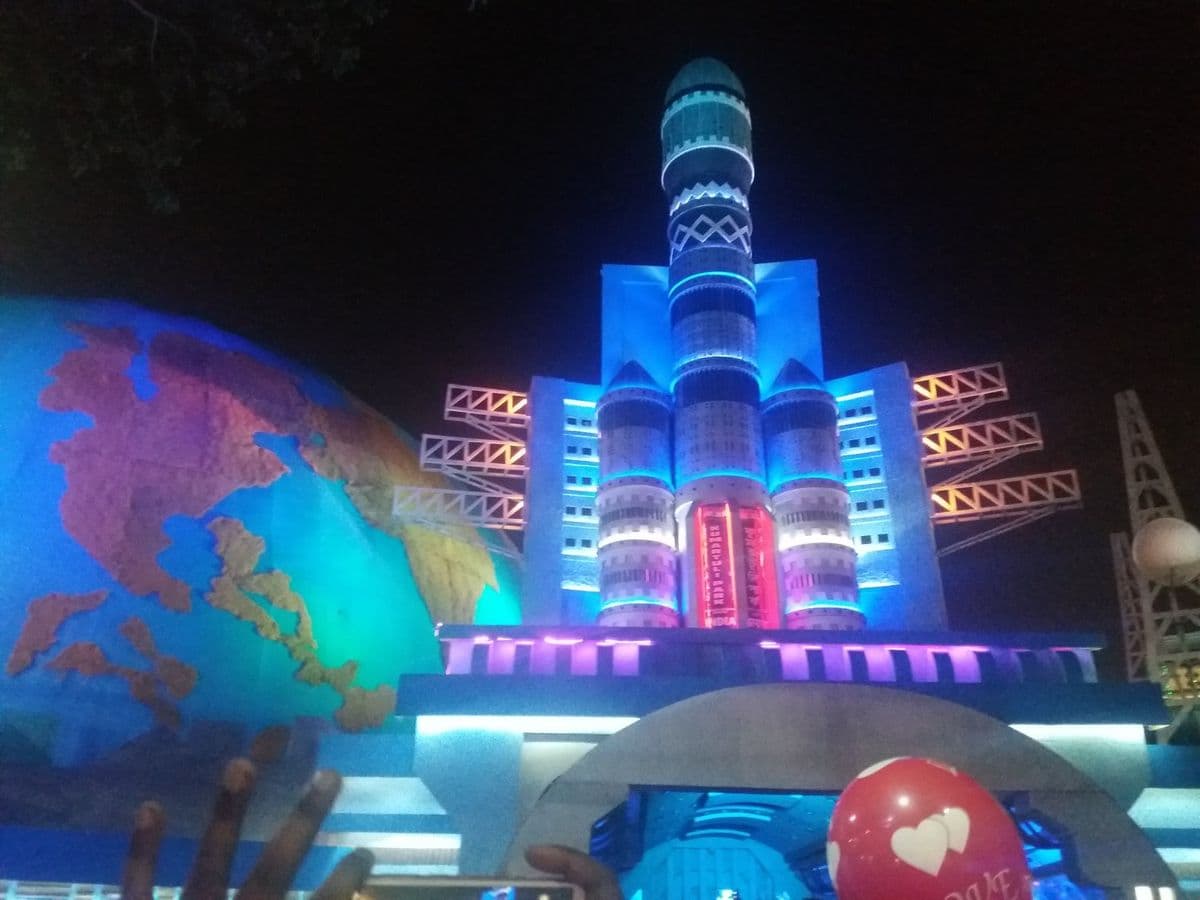
The Kumartuli Park pandal in 2019, one of the north Kolkata pujas that made its name entirely on annual theme design.

The Kumartuli Park pandal in 2019, one of the north Kolkata pujas that made its name entirely on annual theme design.Tarunsamanta, CC BY-SA 4.0, via Wikimedia Commons

Until the 1990s the pandal was a decorated enclosure and the art was the idol. Then Kolkata's competitive pujas began hiring fine artists to design pandal, idol, light and sound as a single installation, with a title, a concept and a curatorial statement, and the festival became the largest open-access public art exhibition on earth. What follows is, in effect, an annual materials research programme. Pandals have been built from jute, terracotta pots, coconut coir, paddy straw, bell-metal utensils, tea cups, bicycle parts, machine scrap, glass bangles, cassette tape and packaging waste. One year it is eight thousand living plants; the next it is upcycled metal salvage; the next it is a courtyard about seed sovereignty.

ইতিহাস History

Where it came from

The theme pujo was not invented in a single season. Its ancestry runs through the baroyari, or subscription, puja — a form whose usual origin story places it at Guptipara in Hooghly in 1790, and which reached Kolkata in recognisably modern shape with the Bagbazar puja of 1909, organised by residents who wanted the goddess out of the zamindar's private thakurdalan and into the street. Through the 1930s the community pujas absorbed the naturalistic idol style, and Simla Byayam Samity's khadi-clad image earned the nickname swadeshi thakur. The decisive technical shift came in the 1950s and 1960s, when set painters and carpenters from the Tollygunge film studios began taking pandal contracts in the off-season and built replicas — the Shish Mahal, the Ajanta caves — out of bamboo, cloth and plaster. That is the true grandparent of the theme pandal: a film set with a goddess in it.

Competition was formalised in October 1985, when Asian Paints launched the Sharad Shamman, the first corporate award for Kolkata's pujas. It added a Discovery of the Year category in 1994 and, in 2000, categories for decorative excellence and for the idol-maker. Judges visit on the fifth and sixth days and announce winners on the evening of Ashtami. Once there was a prize, there was a reason to hire a designer.

The 1990s supplied the money. Liberalisation brought sponsors, and graduates of the Government College of Art and Craft began treating pandals as commissions rather than decoration — among them Sanatan Dinda, born in Kumartuli on 5 February 1971 and a 1992 graduate of the college, and Bhabatosh Sutar, born in Bangladesh in 1974, brought to Kolkata at seven, and now credited with more than fifty theme pujas. The art historian Tapati Guha-Thakurta, who did fieldwork between 2002 and 2012 for In the Name of the Goddess (2015), argues that the label "theme puja" is a local coinage of roughly that period, not an older category. She also wrote the dossier on which UNESCO inscribed Durga Puja in Kolkata on its Representative List in December 2021, and was not credited in it.

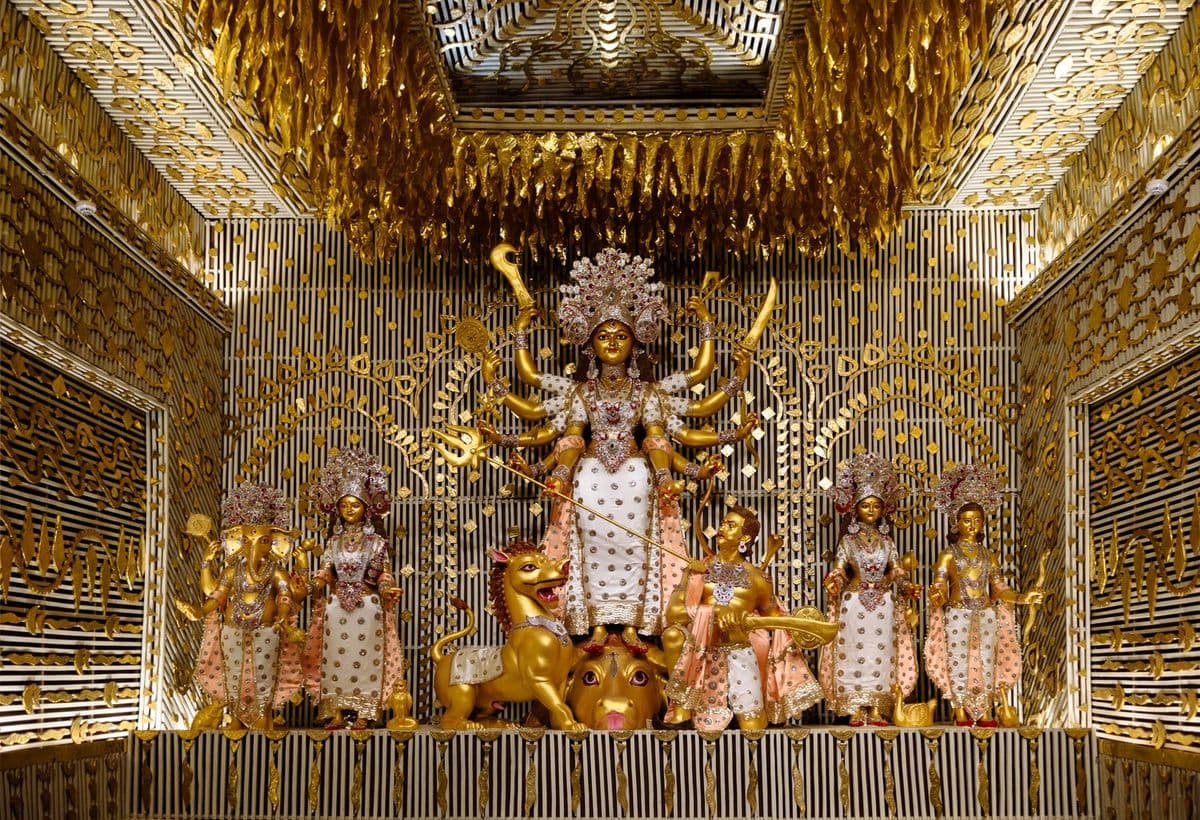
Inside a Kolkata pandal in 2019: a temporary interior built in bamboo and cloth, occupied for five days and then dismantled.
Inside a Kolkata pandal in 2019: a temporary interior built in bamboo and cloth, occupied for five days and then dismantled.Aritra das 21, CC BY-SA 4.0, via Wikimedia Commons

সংস্কৃতি Culture

Who does it, and who used to

Who makes a theme puja is a question with an uncomfortable answer. The designer is usually an art-school graduate on a fee; the work is done by the same hereditary artisan castes who have always done it — Kumbhakar potters, Malakar shola-workers, Sutradhar carpenters, the bamboo teams from Purba and Paschim Medinipur, the light contractors of Chandannagar. Money now enters at the top of that chain rather than the bottom. The patuas and kumors of Kumartuli, many of whom trace descent from the nineteenth-century Kalighat painters, have not been quiet about it: some organisers now commission a small traditional icon for the ritual and a large "art idol" for the crowd, which resolves the theology and leaves the credit dispute intact.

The club is the unit. A para committee collects chanda door to door, negotiates with sponsors, appoints the artist and carries the liability. Most committees are still male-dominated, as is the building trade; women's visible role is concentrated in bhog, in the anjali, and, since 2015 or so, in a handful of pujas that have deliberately put women priests or transgender participants at the centre of the ritual. Not everyone welcomes the change. Ganesh Pyne refused pandal commissions outright, holding that his modernist vocabulary could not be made to serve worship. Meera Mukherjee accepted one in 1990 and gave Kolkata a Durga dressed as a Santhal woman, in the idiom of the communities she had lived among.

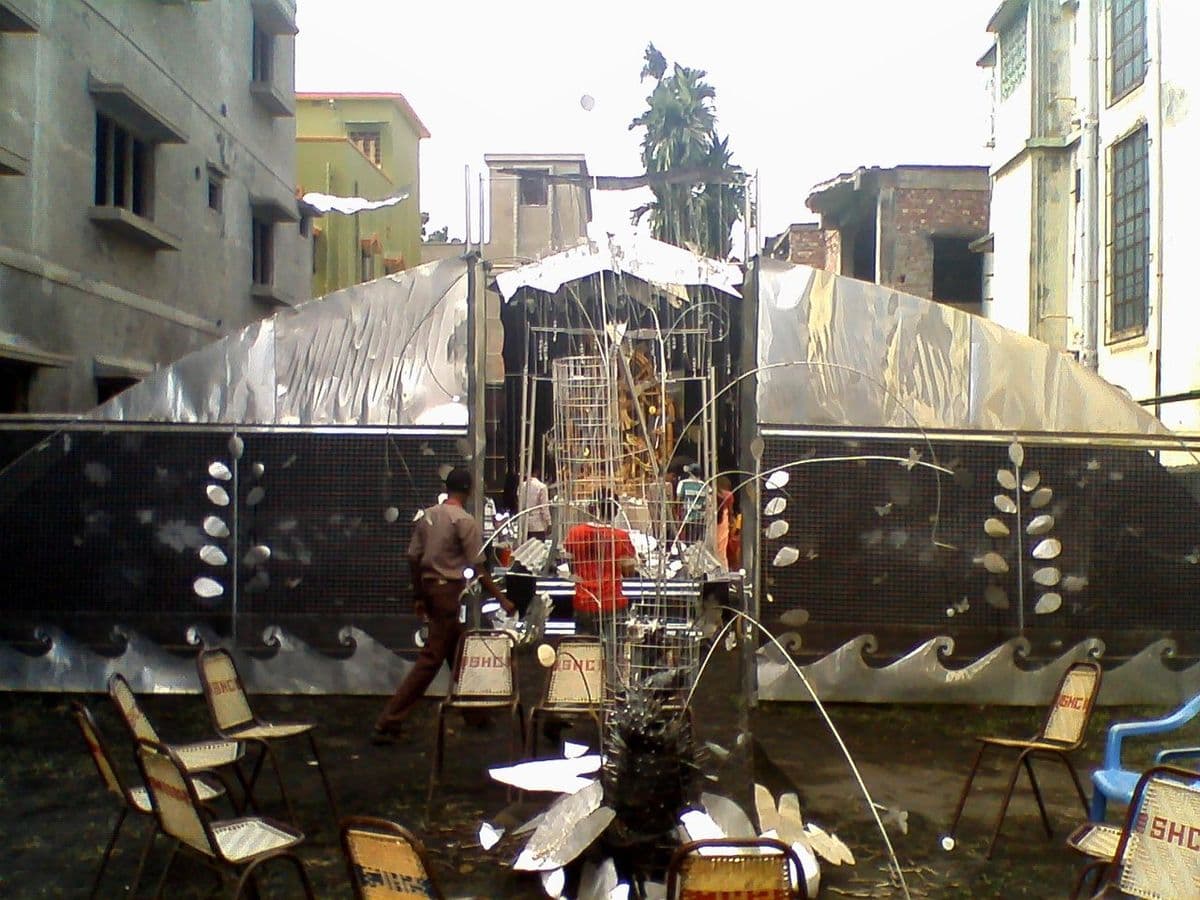
A pandal clad entirely in sheet metal, 2012: the annual materials experiment that the theme puja format makes possible.
A pandal clad entirely in sheet metal, 2012: the annual materials experiment that the theme puja format makes possible.Rakeshmallick27, CC BY-SA 3.0, via Wikimedia Commons

তাৎপর্য Significance

Why this, and not something else

Durga Puja in Kolkata is the largest public art event in the world that nobody has to buy a ticket for. For five days, several thousand temporary buildings stand open in the street, each with a title, a concept and an author, and several million people walk through them at night for nothing. The theme pujo is what turned a decorated enclosure into an exhibition, and in doing so it created an annual, unsubsidised, mass audience for contemporary art in a city where gallery attendance is negligible.

It matters for a second reason. Because the pandal is dismantled in a week, nobody can make it permanent, and so it absorbs experiment that no commissioning body would fund: pandals made of tea cups, glass bangles, bicycle parts, cassette tape, paddy straw, machine scrap. That churn keeps rural crafts in circulation as living materials rather than museum objects, even when the terms of trade are unfair. And it makes the festival an argument about the city — about migrant labour, about rivers, about grief — conducted in public, in bamboo, by people who will take it all down on the sixth day.

Chaltabagan's 2019 puja in Manicktala, north Kolkata, where the idol is designed to sit inside the pandal's concept.
Chaltabagan's 2019 puja in Manicktala, north Kolkata, where the idol is designed to sit inside the pandal's concept.Subhrajyoti07, CC BY-SA 4.0, via Wikimedia Commons

কীভাবে How it is made

The work itself

The primary structure is bamboo (bansh) lashed with coir at every joint, raised after the khuti puja that consecrates the first post to Vishwakarma, usually around Rath Yatra in midsummer. Over that frame goes a secondary skin: plywood, cloth, cane, jute, fibreglass, sheet metal, terracotta, whatever the concept requires. The idol is built separately, on a bamboo-and-straw kathamo packed with Ganga clay (entel mati, then the fine bele mati slip), and finished with the chokkhu daan, the painting of the eyes. Thermocol and plaster of Paris, the cheap workhorses of the 1990s and 2000s, are now restricted: the Government of India banned the manufacture and use of polystyrene among single-use plastics from 1 July 2022, and the Central Pollution Control Board's immersion guidelines require eco-friendly materials for idols and decoration. Lighting is a separate trade, subcontracted almost entirely to Chandannagar, and the sound and the alpona are separate again.

থিম পুজোTheme pujo
A Durga Puja whose pandal, idol, lighting and sound are designed as one authored work around a stated concept; a local coinage of about 2000.
বারোয়ারি / সর্বজনীনBaroyari / Sarbojanin
A subscription puja run by a neighbourhood committee rather than a family; literally 'of twelve friends' and 'for everyone'.
খুঁটি পুজোKhuti puja
The rite that consecrates the first bamboo post of the pandal to Vishwakarma, usually held around Rath Yatra, months before the festival.
চাঁদাChanda
The door-to-door subscription collected from households and shops in the para; still the base layer of finance under the corporate sponsorship.
শারদ সম্মানSharad Shamman
The Asian Paints award, running since October 1985, that made pandal design a competitive, judged and reported activity.
শিল্পীShilpi
Artist. Its contested use for both the art-school designer and the hereditary artisan is the central labour argument of the theme pujo.
কাঠামোKathamo
The bamboo-and-wood armature of the idol, often the same frame recovered from last year's immersion.
চক্ষুদানChokkhu daan
The giving of the eyes: the last stroke of painting, traditionally at dawn on Mahalaya, after which the image can see and be seen.


কাহিনি The stories

What people tell each other about it

Two answers to the same commission

Ganesh Pyne, the most private of Bengal's modernists, was asked more than once to design for a puja and refused every time, on the ground that his vocabulary could not be bent to the service of worship without lying about one or the other. Meera Mukherjee said yes. In 1990 she made a Durga in the idiom of the Santhal communities she had lived and worked among, dressing the goddess in their clothing and abandoning the standard iconography of the Kumartuli workshop. The refusal and the acceptance between them frame the whole argument the theme pujo has been having with itself since: is this art with a goddess in it, or a goddess made by an artist?

October 1985, and the invention of the scoreboard

Asian Paints began handing out the Sharad Shamman in October 1985. It was the first corporate award in the field and it changed the incentives overnight: from roughly three thousand Kolkata pandals, a handful are shortlisted, judges tour on the fifth and sixth days, finalists are named on Saptami and winners announced on the evening of Ashtami. New Alipore Suruchi Sangha has won it twelve times; Sanatan Dinda has taken the best-artisan prize five times, for different pandals. Every other corporate puja award in the city is a copy of this one. Whatever else the theme pujo is, it is a competition with a published result.

The ban that arrived three months early

On 1 July 2022 the Government of India's prohibition on identified single-use plastics took effect, and polystyrene — thermocol — went with it. Thermocol had been the standard carving material for pandal ornament and for the goddess's crown and armour for two decades, because it is light, cheap and takes a knife. The ban landed roughly three months before Durga Puja, with orders already placed and designs already drawn. Some artists had moved on years earlier: Sanatan Dinda said publicly that he had abandoned thermocol long before and was working in iron, paper, several clays and fibreglass. Others lost a season learning to cut shola again.

The dossier with no name on it

When UNESCO inscribed Durga Puja in Kolkata on the Representative List of the Intangible Cultural Heritage of Humanity in December 2021 — the first festival in Asia to be listed — the nomination file had been researched and written by Tapati Guha-Thakurta of the Centre for Studies in Social Sciences, Calcutta, who had been studying the pujas since 2002. Her name does not appear on it. She has described the festival, without much sentiment, as inadequately religious and as a city-wide street exhibition that is also a consumerist carnival, which is roughly what its organisers would say if they were being candid.

দেখুন Watch

Durga Puja in KolkataUNESCOUNESCO's own ten-minute film for the 2021 inscription; the official account of the festival as public art and craft economy.
Durga Puja of Kolkata: Where Art Meets DivinityUNESCO ICHCAPA longer intergovernmental documentary that follows the pandal-building trades rather than only the finished spectacle.
Kolkata's Glorious Durga Puja (India's Mega Festivals)National Geographic IndiaFull-episode broadcast documentary with sustained access to idol-makers and pandal crews during the build.

এখন Now

What state it is in

The British Council's 2019 mapping of the festival's creative economy put its annual value at roughly ₹32,000 crore and at 2.58 per cent of West Bengal's gross state domestic product, covering ten creative industries from idol-making to lighting to publishing. Kolkata alone runs about three thousand pujas; West Bengal runs well over ten thousand. Garland Magazine puts corporate spending in Kolkata at ₹650–950 crore a year, and the festival is commonly credited with more than a hundred thousand seasonal jobs. The pressures now are material and legal rather than aesthetic: the 2022 polystyrene ban landed three months before the puja and left ornament-makers scrambling, and the top designers' fees have pulled away from the artisans' daywork beneath them. The best of the eco-pujas are genuinely research: annual, publicly judged experiments in what you can build a hundred-foot room out of and then compost.

Sources for this page

যা দেবী সর্বভূতেষু বুদ্ধিরূপেণ সংস্থিতা। নমস্তস্যৈ নমস্তস্যৈ নমস্তস্যৈ নমো নমঃ॥

To the Goddess who abides in all beings as intelligence, salutation, salutation, salutation again and again.

Devi Mahatmya 5.20