Ghurni is a quarter of Krishnanagar in Nadia district, on the bank of the Jalangi. In 1728 Maharaja Krishnachandra Roy settled potter families there, brought from Dhaka and from Natore in what is now Bangladesh, and encouraged them to work beyond ritual imagery into portraiture. That instruction is the whole story of the craft: Ghurni's modellers were told to make people, not gods.
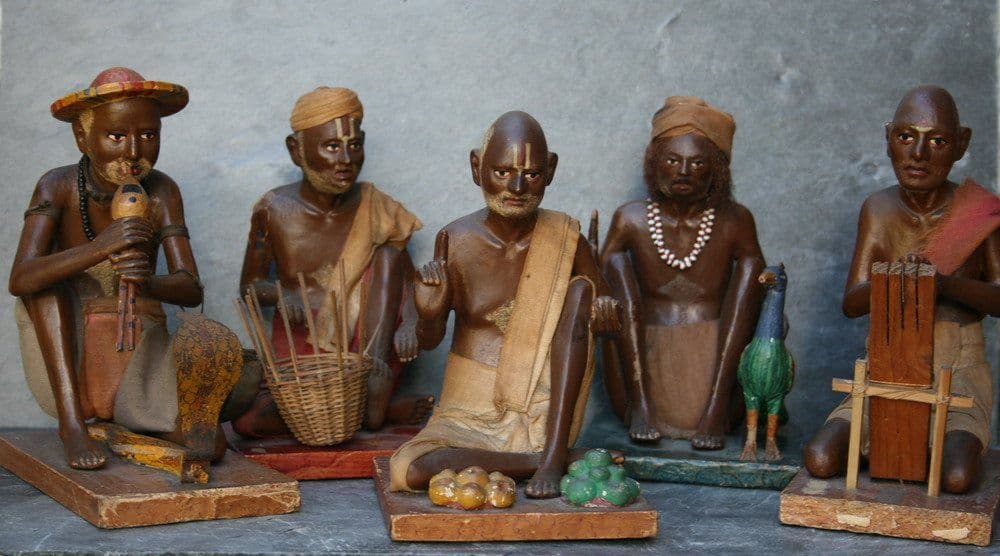
They did it with an accuracy that had no precedent in Bengali clay. The signature of a Krishnanagar figure is anatomical realism — visible veins on a forearm, slack skin at the throat, individually set hairs, the particular slump of a body that has carried weight all day. The subjects followed from the method. The most famous Krishnanagar dolls are not deities but working people: the fisherwoman, the cobbler, the snake-charmer, the barber, the ascetic with his begging bowl.
Through the nineteenth century this made Ghurni a supplier to Europe. Company officials and, later, the international exhibitions bought Krishnanagar figures by the crate as ethnographic specimens — "types of the natives of India" — and the work entered museum collections in London, Paris and Boston. The economic logic was colonial; the artistic result was that a Bengali village acquired a school of secular figurative sculpture two generations before any Indian art college taught one.
In the twentieth century the studios moved between registers without difficulty. Kartik Chandra Pal modelled Gandhi and Tagore in clay; the models were cast in bronze and the resulting statues were unveiled in Washington DC by Bill Clinton and in Moscow by Mikhail Gorbachev. Ghurni also supplies finished Durga images to pujas across Nadia and the Kolkata suburbs, so the ritual and secular lines have never fully separated.